
Table of Contents
- Why Your Event Rental Backup Plan Matters
- Building Your Event Contingency Plan Template
- Outdoor Event Weather Backup Plan Essentials
- Event Rental Equipment Failure Protocol
- Emergency Evacuation Plan for Tented Events
- Staffing, Vendor, and Communication Redundancy
- Insurance, Liability, and Financial Protection
- Your Event Is Protected, Now Plan Ahead
Last Updated: August 7, 2026
Why Your Event Rental Backup Plan Matters
An event rental backup plan isn’t optional, it’s the difference between a smooth celebration and one derailed by a single failure. Weather shifts, equipment breaks, vendors cancel, power fails, staff don’t show up. A solid backup plan ensures that when something goes wrong, and statistically, something always does, you have a documented response that keeps your guests safe, your timeline intact, and your budget from spiraling.
A comprehensive event rental backup plan reduces stress on event day and protects your guests, your timeline, and your investment. The best time to build it is weeks before the event, not hours before.
Building Your Event Contingency Plan Template
Your event contingency plan template should be a living document, specific to your event, your venue, and your actual resources. Start by identifying critical functions that must continue if something fails: catering, seating, shelter, entertainment, communication, and safety. For each function, write down what could go wrong and what the backup is.
Assign ownership. Every contingency needs a point person responsible for executing that backup if needed. If the DJ cancels, Sarah calls the backup DJ and confirms they can arrive within two hours. Document all vendor contact information in one place: primary vendors, backup vendors, emergency services, venue management, equipment suppliers. Include cell phone numbers, not just office lines.
Set decision thresholds. At what point do you activate a backup? "If it rains" is too vague. "If rainfall exceeds 0.5 inches within two hours of event start" is actionable. Include a timeline showing when decisions must be made, a weather backup decision often needs to happen 24 hours before the event, while a power failure backup needs immediate activation.
Finally, test your plan mentally. Walk through a failure scenario. If you can’t answer critical questions with your plan in hand, the plan isn’t complete yet.
Outdoor Event Weather Backup Plan Essentials
Weather is the most common reason events need a backup plan. A comprehensive outdoor event weather backup plan addresses rain, wind, extreme heat, and lightning, each requiring different responses.
For rain, the first decision is shelter. A 20×40 tent covers 800 square feet, roughly 100 standing guests or 40 seated guests. Know your guest count and calculate tent size accordingly. Have the tent company deliver and set up at least two hours before the event. Confirm with the rental company in writing: delivery date, setup time, takedown time, and what happens if weather forces last-minute changes.
Wind is trickier than rain. Tents can handle moderate wind, but sustained winds above 30 mph create safety risks. Your weather contingency should specify: if sustained winds exceed 25 mph, we move the event indoors or postpone. Check the forecast in the 24 hours before the event and confirm with your tent rental company that they’ll monitor conditions.
Extreme heat requires shade, cooling stations with ice water and electrolyte drinks, misting fans, and a contingency to move the event earlier in the day or to an air-conditioned backup venue. Lightning is non-negotiable. The moment lightning is visible, outdoor events must move indoors or guests must seek shelter.
Create a weather monitoring protocol. Assign someone to check the forecast every 12 hours in the week before the event. At 24 hours out, check every 6 hours. At 6 hours out, check every hour.
Postponing an outdoor event due to weather is far better than proceeding and having guests injured or uncomfortable. A single heat-related emergency or lightning strike can create liability that overshadows the entire event. Plan to cancel or move indoors if conditions warrant it.
Event Rental Equipment Failure Protocol
Equipment fails. Bounce houses develop seams that leak. Sound systems lose power. Generators overheat. Your event rental equipment failure protocol determines whether a failure becomes a minor inconvenience or a major disaster.
Start with pre-event inspection. Schedule a walkthrough with the rental company 24 hours before the event. Check every piece of equipment and document any issues in writing. For critical equipment, have a backup on standby. If the DJ is the centerpiece of your event, identify a backup DJ who can arrive within 90 minutes if needed.
Establish a communication protocol with your rental company. Get a direct cell phone number for the person managing your event. Confirm in writing: if equipment fails, you’ll call this number, and they’ll respond within 15 minutes with a plan to fix or replace it.
Document the rental agreement carefully. What does the company guarantee? Are they responsible for setup and takedown? What happens if equipment fails due to weather, guest misuse, or company negligence? Get these answers in writing before you sign.
Emergency Evacuation Plan for Tented Events
A tented event evacuation plan is a legal and safety requirement. Start with the venue. How many exits does the tent have? A tent should have at least two exits, clearly marked and unobstructed.
Mark evacuation routes clearly. Use bright tape, signs, or lighting to show the path from every area of the tent to each exit. Brief staff on the evacuation procedure before guests arrive. Assign roles: who directs people to exits? Who checks bathrooms and secluded areas? Who communicates with emergency services? Who accounts for guests once they’re outside?
Identify a muster point, a safe location outside the tent where guests gather after evacuation. This should be away from the tent, away from traffic, and away from any hazards.

Know your venue’s emergency procedures. Get a copy of any existing emergency action plan and coordinate with it. Document your evacuation plan in writing. Include a diagram of the tent showing exits, routes, and the muster point. Include the names and roles of staff responsible for evacuation. Include emergency contact numbers. Keep this document with you during the event.
Staffing, Vendor, and Communication Redundancy
Events depend on people showing up and doing their jobs. For each critical role, identify a backup, someone trained and ready to step in if needed.
Confirm vendor commitments in writing. A written contract should specify: arrival time, setup time, what they’ll provide, what happens if they’re late or don’t show, and what compensation you’ll provide. Include a clause: "If [vendor] cannot arrive as scheduled, [backup vendor] will be contacted immediately."
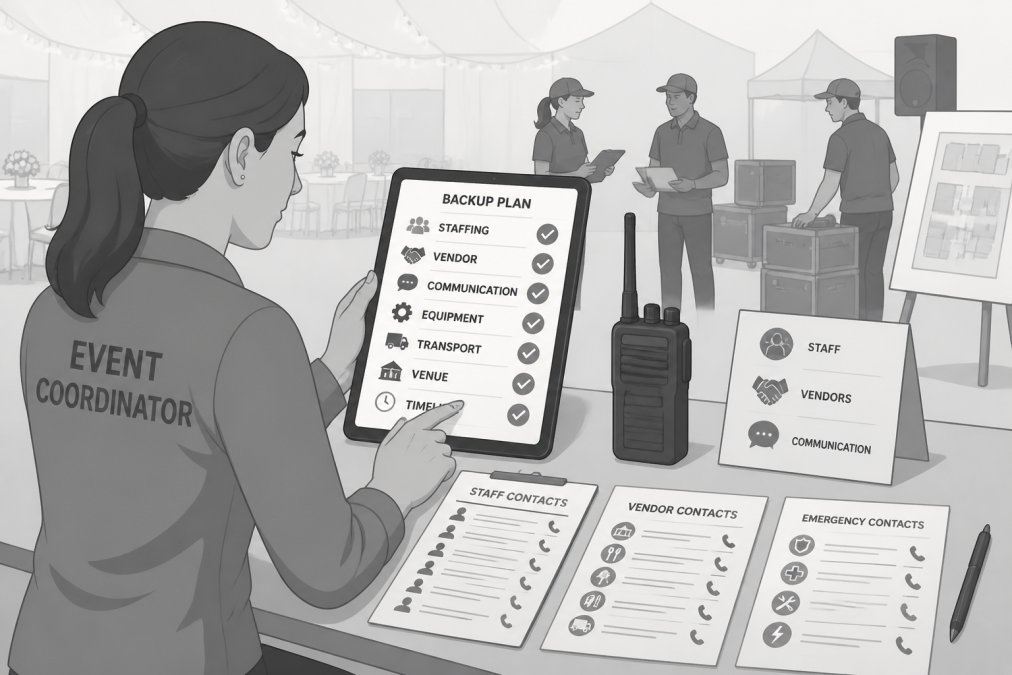
Create a communication chain. If something goes wrong, who calls whom, and in what order? Write it down with all contact information: names, cell phone numbers, and backup phone numbers. Use phone calls during emergencies, not email or text.
Brief all staff on the communication protocol before the event. Everyone should know: if you see a problem, who do you tell? How do you tell them? For vendor no-shows, have a contingency timeline. If a vendor is 30 minutes late with no communication, activate the backup.
Document all communications during the event. Who called whom, when, and what was said? This creates a record that’s invaluable if something goes wrong and there are questions later.
Insurance, Liability, and Financial Protection
An event rental backup plan isn’t just operational. It’s financial and legal. Review your event liability insurance before the event. What does it cover? Does it cover injuries at your event? Does it cover damage to rented equipment? Does it cover weather-related cancellations? Most standard homeowner’s or renter’s insurance does not cover events. You likely need event-specific liability insurance.
Work with an insurance agent to understand your coverage. Ask specifically: if a guest is injured at my event, am I covered? If rented equipment is damaged, who pays? Get answers in writing.
Review the rental agreement for each piece of equipment. Who’s liable if the equipment fails and causes injury? Understand these terms before you sign.
Budget for contingency costs. A backup tent, a backup DJ, a generator, these cost money. If your event budget doesn’t include a 10-15% contingency fund, you’re underfunded.
Document all agreements and communications related to your event. Keep copies of rental agreements, vendor contracts, insurance policies, and email confirmations. If a dispute arises later, documentation protects you.
Post-emergency communication is often overlooked but critical. After an incident, even a minor one, send a follow-up email to key stakeholders documenting what happened, what was done, and what the outcome was. This creates a record and demonstrates that you handled the situation professionally.
Your Event Is Protected, Now Plan Ahead
Building an event rental backup plan takes time. It requires thinking through failure scenarios that you hope never happen. But the investment pays off the moment something goes wrong. You’ll have a response ready. Your guests will be safe. Your event will continue.
Start with the template. Customize it for your specific event, venue, and resources. Assign ownership for each contingency. Document everything. Brief your team. And then, with confidence, host your event knowing you’re ready for whatever comes.
When you’re sourcing rental equipment, tents, bounce houses, tables, chairs, sound systems, work with a partner who understands contingency planning. RI Party Store has served Rhode Island and Southeastern Massachusetts families and event planners for years. We provide high-quality, clean rental equipment with professional delivery and setup. More importantly, we understand that events don’t always go as planned. Our team is responsive, flexible, and ready to work with you on backup solutions if something doesn’t go as expected. When you’re selecting your rental partners, choose ones who take contingency planning as seriously as you do.
Frequently Asked Questions
What should be included in an event rental backup plan?
A solid event rental backup plan covers six core areas: weather contingencies (tent rental alternatives, indoor venues), equipment failure protocols (vendor contact lists, replacement equipment sources), staffing redundancy (backup staff, clear communication chains), power and electrical failure mitigation (generators, battery-powered lighting), vendor and supplier redundancy (multiple rental companies on standby), and emergency communication protocols (group messaging systems, contact trees). Document each area with specific vendor contacts, phone numbers, and activation triggers so your team knows exactly when and how to execute the backup plan.
How do you handle equipment failure during an event?
Establish an event rental equipment failure protocol before your event date. Require your rental vendor to provide a backup equipment list and response time guarantee in writing. On event day, designate one team member as the equipment point person with direct vendor contact information. If equipment fails, call your vendor immediately and activate your secondary rental company simultaneously. Keep on-site emergency supplies like extension cords, duct tape, batteries, and flashlights in an accessible kit. Document the failure with photos for insurance purposes. Most reputable rental companies can replace or repair standard items within 30-60 minutes if you've established the protocol in advance.
What is a contingency plan for an outdoor event?
A contingency plan for an outdoor event is a documented set of alternative actions triggered by specific problems. For outdoor events, this means identifying weather thresholds (wind speed, rain, temperature) that activate your backup plan, securing a tented or indoor alternative venue, arranging equipment adjustments (weighted tent stakes, weatherproof coverings), and establishing communication procedures to notify guests if the plan changes. Your outdoor event weather backup plan should include specific go/no-go decision times (typically 24-48 hours before) so vendors have time to adjust delivery and setup. Include contact information for all backup venues and vendors, plus a communication template to send guests if the location or timing changes.
What legal responsibilities do event organizers have for emergency planning?
Event organizers have a duty of care to guests under premises liability law. This means you must identify foreseeable hazards, implement reasonable safety measures, and have an emergency response plan. Insurance carriers typically require documented evacuation procedures, emergency contact information posted on-site, and staff training on incident response. For tented events, local building codes may mandate specific safety standards, exit routes, and occupancy limits. Check with your venue and local fire marshal about requirements. Include liability clauses in rental contracts specifying vendor responsibilities for equipment safety and your responsibilities for guest supervision. Document your emergency planning efforts; this demonstrates due diligence if a claim occurs and can reduce your liability exposure.
The difference between an event that survives a crisis and one that becomes a disaster is preparation. Your event rental backup plan is that preparation. Build it now, review it regularly, and execute it confidently when needed. Your guests, and your peace of mind, will thank you.
This article was written using GrandRanker