
Sesame Street Bounce House: What Parents Need to Know
Table of Contents
- Why a Sesame Street Bounce House Wins for Toddler Parties
- Bounce House Rental Requirements: What You Need Before Booking
- Inflatable Safety Standards Every Rental Company Should Meet
- Party Planning Checklist for Toddlers: Timing, Themes, and Treats
- Sesame Street Bounce House Sizes, Themes, and Character Graphics
- Renting vs. Buying a Sesame Street Bounce House
- Cleaning, Maintenance, and Backup Plans for Rental Day
- Frequently Asked Questions
Last Updated: September 10, 2026
Why a Sesame Street Bounce House Wins for Toddler Parties
A Sesame Street bounce house solves the hardest problem in toddler party planning: keeping two- to five-year-olds happily occupied for more than ten minutes. The familiar characters do the work before the kids even climb in, and the low walls and soft surfaces suit small bodies better than a castle built for eight-year-olds.
Parents searching for a Sesame Street bounce house in Rhode Island and Southeastern Massachusetts usually land on the same three questions: will it fit in my yard, is it safe for a three-year-old, and what does the rental require? This guide from RI Party Store answers those directly.
The short answer on fit: most toddler units need a flat area roughly the size of two parked cars, plus a dedicated outlet within reach of the blower cord.
Bounce House Rental Requirements: What You Need Before Booking
Bounce house rental requirements come down to three things: a flat surface, enough clearance, and a working power source. Rental companies ask about all three at booking because a sloped lawn or blocked outlet means the unit cannot be safely anchored or inflated.
Space, Surface, and Power Checklist
- Flat ground: Grass, pavement, or turf with no more than a slight slope. Roots, rocks, and sprinkler heads should be cleared first.
- Clearance: Remove low branches and keep the unit away from fences, pools, and play structures.
- Power: A standard grounded outlet within reach of the blower cord (osha.gov). The blower runs continuously, so the circuit should not share with kitchen appliances or AC units.
- Surface protection: A tarp or mat under the unit on pavement, which most rental companies provide.
- Access: A clear path at least as wide as the unit for the delivery crew to move equipment to the setup spot.
Confirm these before the truck arrives, rescheduling on party day is the most avoidable rental problem.
Never run a bounce house blower off a generator unless the rental company confirms it can handle the continuous load. An undersized generator causes the unit to deflate mid-party, and a partially inflated bouncer is a genuine fall hazard.
Inflatable Safety Standards Every Rental Company Should Meet
Inflatable safety standards in the United States are set largely through voluntary industry guidelines and manufacturer specifications, not a single federal law (cpsc.gov). That makes the rental company’s own practices the real safety net.
Reputable operators follow several consistent practices:
- Anchoring: Ground stakes on grass, sandbags or weights on pavement. A unit that is not anchored can lift in a gust even with children inside.
- Weight capacity: A stated limit for the specific unit, enforced by the attendant or by the number of kids allowed in at once.
- Age separation: Toddler units kept separate from units for older children, since mixed ages are where most collisions happen.
- Attendant supervision: Either a provided attendant or a clear handoff of supervision duties to a parent.
- Manufacturer documentation: Units that carry proper labeling and meet the relevant safety specifications for commercial-grade inflatables.
Ask any rental company how they anchor on your specific surface, and who supervises. The answers tell you more than any brochure.
What Parents Should Verify on Delivery Day
Supervision is the single most important safety factor, and it belongs to an adult, not an older sibling. On delivery day, walk the unit before the kids get near it.
- Check that all anchor points are secured and the unit is fully inflated with no soft spots.
- Look for tears, exposed seams, or a fraying blower cord.
- Confirm the entrance and exit are clear and the safety net is intact.
- Ask the crew to show you the on/off switch and the deflation procedure.
- Set your own house rules: no shoes, no food or drinks inside, no flipping, one at a time down any slide.
Take a photo of the anchored unit and the blower connection before the party starts. If anything shifts or the blower cuts out, you have a reference for what “correct” looked like, and it speeds up any support call.
Party Planning Checklist for Toddlers: Timing, Themes, and Treats
A party planning checklist for toddlers should assume a short attention span and an early bedtime. Two hours is the sweet spot. Anything longer and you are managing meltdowns, not celebrating.
Timing that works:
- Schedule around nap time, not through it. Late morning or early afternoon suits most toddlers.
- Keep the structured part (cake, presents) to about 30 minutes.
- Let the bounce house carry the free-play time, since it holds attention longer than organized games at this age.
Themes and treats:
- Pick one theme and repeat it across plates, balloons, and the inflatable. A Sesame Street theme is forgiving because the characters are already familiar to the age group.
- Keep food simple and mess-free. Cupcakes beat a tiered cake for small hands.
- Have a quiet corner with a few books for the child who needs a break from the noise.
The most reliable toddler party formula is a short window, one strong activity, and food that does not require a fork. The bounce house is the activity. Everything else is support.
Sesame Street Bounce House Sizes, Themes, and Character Graphics
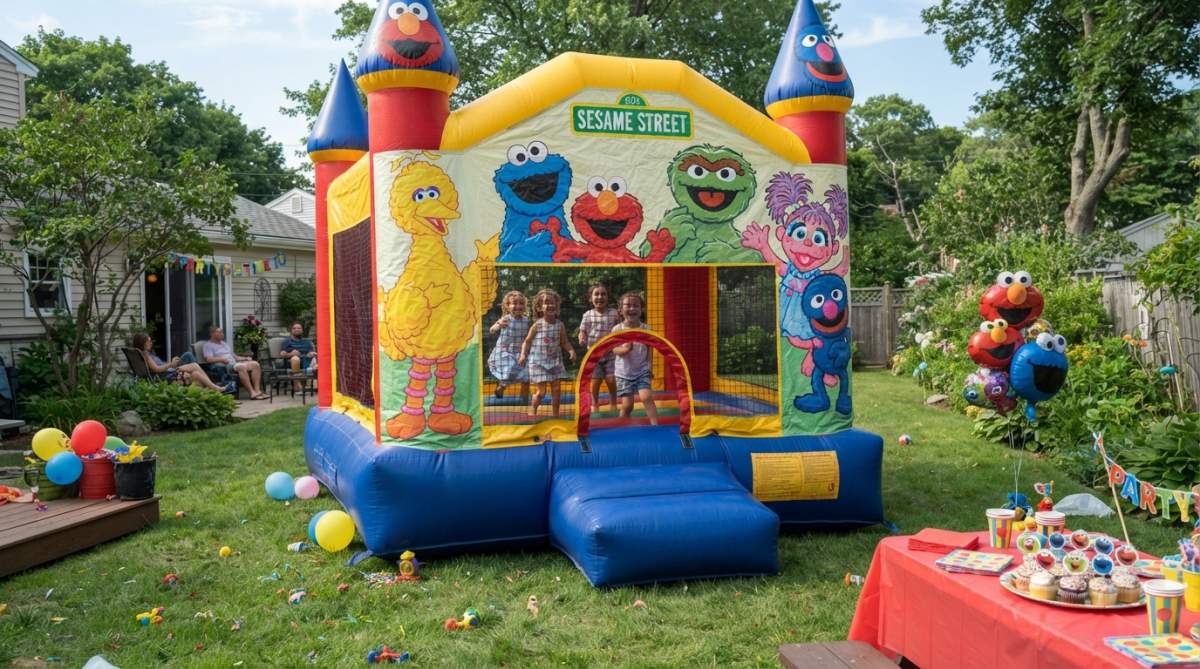
Sesame Street bounce house sizes typically range from compact toddler units to larger combo inflatables with a slide attachment. Most toddler-focused models fit a standard backyard, while combo units need more room and taller clearance. The inflated footprint, not the packed size, is what has to clear your fence line, patio, and low branches.
Typical Size Classes and What They Demand
Manufacturers do not publish one universal spec sheet, so treat the ranges below as the classes you will be quoted, then confirm exact numbers for the unit you book.
- Compact toddler bouncer: roughly 8 to 10 feet square inflated, about 7 to 8 feet tall. Fits a small side yard or a two-car driveway pad with room to walk around it.
- Standard themed bouncer: roughly 13 to 15 feet square, about 8 to 9 feet tall. This is the most common backyard size and the one most families picture.
- Combo unit with slide: roughly 15 to 20 feet long by 13 to 15 feet wide, about 10 to 12 feet tall. The slide adds length, not just height, so it needs a longer rectangle rather than a square.
Add roughly 2 to 3 feet of clearance on every side for the blower hose, anchor points, and a safe walking path. A 15-foot unit effectively occupies a 20-foot circle of usable ground.
Capacity Math You Can Actually Use
Toddler units are built for a small number of children at once, which is a feature, not a limitation. A common industry pattern is a total weight limit plus a per-child guideline, and the lower governs: usually four to six children ages two to five bouncing at once, with a rotation line outside (astm.org).
If you are inviting more than six toddlers, plan on a rotation rather than a bigger unit, a larger bouncer just gives three-year-olds more room to collide.
Character Graphics: What Survives a Season
What separates a good themed unit from a generic one is the graphics. Digitally printed character graphics on commercial-grade vinyl hold color far better than painted or stitched-on panels, which fade and peel after a season of sun. Ask whether the graphics are printed directly onto the vinyl or applied as decals; printed ones survive repeated cleaning and outdoor use.
Three questions worth asking before you book:
- Are the graphics printed into the vinyl or applied on top?
- Is the unit commercial-grade, or a consumer inflatable being rented out?
- Has this specific unit been in service long enough to show how the colors hold up?
Measure Before You Book
Walk your yard with a tape measure and mark the rectangle with string or cones. Check three things: the flat rectangle, the vertical clearance above it, and the path from the street to that rectangle. If the crew cannot get a folded unit through the gate, the footprint does not matter.
Write down four numbers before you call: length, width, overhead clearance, and gate width. Any rental company can quote you accurately in one call if you have those, and you will avoid the most common party-day surprise, a unit that fits the yard but not the access path.
Renting vs. Buying a Sesame Street Bounce House
Renting beats buying for almost every family, and the math is not close, but most rental pages never explain where the line falls. Here is the decision framework.
The True Cost of Ownership
A commercial-grade inflatable is a significant purchase, and the sticker price is only the first line item. Ownership carries four recurring costs that rental pricing bundles:
- Storage: A folded commercial unit still takes up serious space. It needs dry, secure, pest-free storage, a garage corner works, a damp shed does not. Vinyl that stays wet grows mildew.
- Cleaning and sanitizing: Every use requires a full wipe-down, a dry time, and a repack. Skip it and the unit smells by the third event.
- Inspection and repair: Seams, blower cords, and anchor points wear. A patch kit handles small failures; a failing seam does not.
- Liability and supervision: When you own the unit, you own the supervision problem at every event, not just your own party.
Add those up and a purchase only pencils out across many events per year.
When Buying Actually Makes Sense
Buying is the right call in a narrow set of situations:
- You host five or more events a year where the inflatable is the main activity.
- You have a community role, a school, church, HOA, or daycare, with regular functions and a place to store a large vinyl unit.
- You want a small consumer-grade unit for one or two children in a fenced yard, and you accept that it is a toy, not a commercial attraction. These are lighter, cheaper, and not built for the wear of a rental fleet.
If none of those describe you, renting wins on every axis that matters: no storage, no maintenance, professional setup and takedown, and equipment inspected between uses.
The Decision Table
| Factor | Rent | Buy |
|---|---|---|
| Upfront cost | Per-event fee | Full purchase price |
| Storage | None | Needs dry, secure space |
| Maintenance | Handled by company | Your responsibility |
| Setup and takedown | Included | You do it |
| Inspection and cleaning | Between rentals | On you |
| Liability and supervision | Shared with operator | Entirely yours |
| Best for | One or two parties a year | Frequent hosts with storage |
The Hybrid Answer Most Families Miss
You do not have to choose one forever. A common pattern is to rent a commercial-grade themed unit for the big birthday and buy a small consumer bouncer for everyday backyard use, the safety and presentation of commercial equipment where it matters, without the storage and maintenance burden of owning one.
For most families, the rental fee is the cheaper and safer path, especially when the company handles delivery, setup, and pickup.
If you are weighing a purchase, price out storage and cleaning time before you compare it to a rental fee. The fee looks larger until you count the hours and the garage space.
Cleaning, Maintenance, and Backup Plans for Rental Day
Cleaning and maintenance standards are where rental companies separate themselves, and they are hard to judge from a website. A clean unit arrives fully inflated, free of debris, and dry. A poorly maintained one shows up with sand in the corners, a musty smell, or a slow leak that turns into a deflated bouncer by hour two.
Ask two questions before booking: how is the vinyl sanitized between rentals, and what is the backup plan if something fails on party day? A dependable operator can swap a damaged unit if a repair will not hold.
Book with a company that services your town reliably rather than one at the edge of its delivery radius. A short delivery radius means faster response if a unit needs replacing mid-party, and less risk of a late arrival that eats into your rental window.
Planning a toddler party is mostly logistics, and the bounce house is the piece with the most variables. RI Party Store handles those variables for families across Rhode Island and Southeastern Massachusetts, with clean commercial-grade inflatables, professional delivery and setup, and a backup plan if anything goes wrong on the day. Choose from themed bounce houses, foam parties, and balloon décor, all under one roof, with in-store pickup or delivery to your door. Get started with RI Party Store and turn the party into the easy part of the week.
Frequently Asked Questions
Are Sesame Street bounce houses safe for toddlers?
Yes, when the rental meets current safety standards and the toddler meets the minimum age and height set by the operator. Look for a fully enclosed bounce area with mesh netting, a padded entrance ramp, and an anchored base. An adult should supervise at all times, and the number of children bouncing at once should stay within the posted weight capacity. Ask the rental company for their inspection and sanitization records before booking.
What should I look for when renting a character-themed bounce house?
Check that the unit uses commercial-grade vinyl, digitally printed character graphics that will not peel, and a covered air blower with a grounded power cord. Read the rental agreement for weather and cancellation terms, and ask how the inflatable is cleaned between events.
How much space is required for a standard bounce house rental?
A typical toddler-sized unit needs a flat area of roughly 15 by 15 feet, plus clearance for the blower and a safe distance from fences, trees, and utility lines. Add extra room for the entrance path and for adults to walk around the unit. Measure your setup area before booking, and tell the rental company about any slopes, sprinklers, or low branches so they can plan the placement.
How far in advance should I book a themed bounce house?
Book two to four weeks ahead for a standard weekend party, and four to six weeks for peak seasons like late spring and early fall. Holiday weekends and popular character themes fill up fastest. If your event falls on a Saturday in June or September, reserve as early as possible. Confirm delivery window, setup time, and pickup schedule in writing when you book.