
Toy Story Bounce House Rental: How to Plan a Party
Table of Contents
- What to Expect From a Toy Story Bounce House Rental
- How to Choose a Bounce House Size for Your Yard or Venue
- Bounce House Safety Guidelines Every Parent Should Know
- A Party Planning Timeline for Kids’ Birthdays
- Rental Pricing, Availability, and Booking Deposit Basics
- Maintenance and Sanitation Standards to Ask About
- Frequently Asked Questions
Last Updated: September 11, 2026
What to Expect From a Toy Story Bounce House Rental
A Toy Story bounce house rental brings Woody, Buzz, and the rest of the gang into your backyard as a licensed-character inflatable built for active play. These units often become the centerpiece of countless birthday parties, and the pattern is always the same: kids sprint toward it the second it inflates.
That enthusiasm is exactly why the details matter before you book. A rental isn’t just a big balloon your child jumps in. It’s a piece of commercial-grade equipment with specific power needs, space requirements, and safety systems that determine whether the day runs smoothly or turns into a scramble.
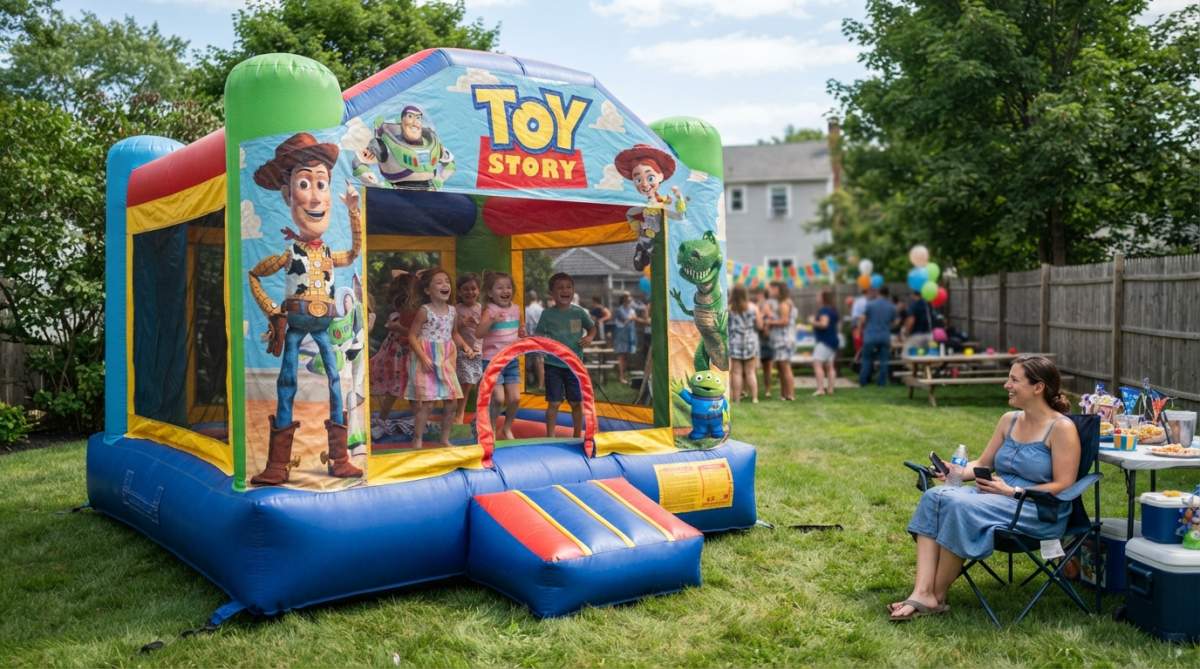
Here’s what most first-time renters don’t realize: the inflatable itself is only half the booking. Delivery, setup, anchoring, and takedown are part of the package, and a reputable company handles all of it. The American Society for Testing and Materials standards for amusement rides guide the manufacturing and safety benchmarks that quality rental operators follow.
Combo Units, Slides, and Interactive Features
Not every Toy Story bounce house is the same structure. Rental companies typically stock a few configurations, and knowing the difference helps you match the unit to your crowd.
A standard moon bounce is a single jumping area with mesh siding for visibility. A combo unit adds a slide, a climber, or both, turning the inflatable into a mini obstacle course. Combo units with a wet or dry slide give you flexibility: run it dry for a spring birthday, hook up a hose for a summer party.
Interactive extras vary by model. Common add-ons include a basketball hoop inside the jump area, a pop-up shooting gallery, and character graphics printed across the exterior panels. Licensed characters like Woody, Buzz Lightyear, and Jessie usually appear on the entrance step and side walls.
| Unit Type | Best For | Typical Features |
|---|---|---|
| Standard moon bounce | Toddlers, small groups | Open jump area, mesh siding |
| Combo with slide | Mixed ages | Dry slide, climber, jump zone |
| Wet/dry combo | Summer parties | Hose attachment, splash slide, jump zone |
A common mistake is booking a combo unit for a group of three-year-olds. The slide and climber add height and complexity that younger kids can’t navigate safely without constant supervision. Match the unit to the youngest guest, not the oldest.
How to Choose a Bounce House Size for Your Yard or Venue
Sizing a bounce house is a math problem, not a guess. You need three numbers: the inflatable’s footprint (the ground it covers), its height (critical for indoor venues and low branches), and the clearance zone (the empty buffer that keeps jumpers from hitting fences, grills, or garden beds).
Most residential rentals fall into a few recognizable size classes. Exact dimensions vary by manufacturer and model, so always confirm the spec sheet for the specific unit you’re booking, but these ranges reflect what rental operators commonly stock:
| Size Class | Typical Footprint | Typical Height | Rider Capacity | Best For |
|---|---|---|---|---|
| Small / toddler | ~10 x 10 ft | ~7-8 ft | 4-6 young kids | Ages 2-5, tight yards |
| Standard | ~13 x 13 ft | ~8-9 ft | 6-8 kids | Most backyards |
| Combo with slide | ~15 x 20 ft+ | ~10-12 ft | 8-10 kids | Mixed ages, bigger lawns |
| Wet/dry combo | ~15 x 25 ft+ | ~10-12 ft | 8-10 kids | Summer parties with hose access |
Those footprints are the inflatable alone. Add a clearance buffer on every side, most operators recommend at least 3 feet on the sides and back, and 6 feet or more at the slide exit so kids have a safe runout. A combo unit that lists a 15 x 20 ft footprint effectively needs a 21 x 32 ft flat area once clearance is included.
A Simple Space-Planning Method
- Measure the flat, level ground, not the whole yard. Slopes, sprinkler heads, tree roots, and low branches all disqualify space.
- Subtract the clearance zone from your usable area before you compare it to any footprint.
- Check the approach path. A 15-foot-wide inflatable still has to fit through your gate and around the corner of the house. Measure the narrowest point on the delivery route.
- Confirm overhead clearance for indoor setups. Gyms, community halls, and church basements work well, but a 12-foot-tall combo unit needs a ceiling that clears it with room to spare.
- Verify the power run. The blower needs a dedicated outlet within reach of an outdoor-rated extension cord, usually within 50-100 feet, depending on the cord gauge.
Measure the actual flat, level space, not the total yard. A sloped lawn that looks generous on paper often has only a small usable patch once you account for the inflatable’s footprint and the required clearance.
If you’re booking a venue rather than a home, confirm the indoor ceiling height and floor surface before you reserve. Carpeted floors need an anchoring plan that doesn’t damage the surface, sandbags rather than stakes, and hard floors need non-marking protection under the blower and anchor points.
When in doubt, send the rental company your measurements and a photo of the setup area. A good operator will tell you which units fit and which don’t before you pay a deposit.
Bounce House Safety Guidelines Every Parent Should Know
Bounce house safety guidelines exist for one reason: inflatables concentrate a lot of kinetic energy in a small space. Following them protects your guests and keeps the rental company’s insurance valid.
The basics are non-negotiable. Enforce a rider capacity limit, group kids by size, and never let adults and toddlers jump together. Remove shoes, glasses, and anything sharp before entry. A trained operator should walk you through the rules at setup, and you should pass those rules to every parent at the party.
U.S. Consumer Product Safety Commission guidance on inflatable amusement rides outlines the injury patterns that proper supervision prevents. Most incidents trace back to overcrowding or unsupervised mixed-age jumping, not equipment failure.
Never move or reposition an inflatable once it’s anchored and inflated. Shifting the unit can pull stakes loose or tip the blower, and a partially deflated bounce house is a genuine hazard.
Setup Area, Clearance Zone, and Anchoring System
Three components keep a bounce house stable: the setup area, the clearance zone, and the anchoring system. Get any one wrong and the unit becomes unsafe.
The setup area is the flat, level ground the inflatable sits on. The clearance zone is the empty buffer around it, kept free of people, pets, and objects. The anchoring system is what holds it down, typically ground stakes for grass or sandbags for pavement and indoor surfaces.
A blower unit runs continuously to keep the structure inflated, which means you need a dedicated circuit nearby. Daisy-chaining the blower with a DJ setup or catering equipment will trip a breaker mid-party. Ask the rental company about voltage requirements and bring an extension cord rated for outdoor use.
A Party Planning Timeline for Kids’ Birthdays
A party planning timeline for kids should start at least three to four weeks out, with the bounce house booked early because weekend availability disappears fast during birthday season.
Here’s a workable sequence that keeps the day from becoming a fire drill:
- 4 weeks out: Set the date, guest count, and venue. Book the bounce house and confirm delivery window.
- 3 weeks out: Send invitations. Order themed tableware, balloons, and party favors.
- 2 weeks out: Plan the food and cake. Confirm the setup area is clear and the power source is accessible.
- 1 week out: Finalize the guest list. Confirm the rental booking and delivery time in writing.
- Day before: Clear the setup area, mow the lawn if needed, and check the weather forecast.
- Day of: Receive delivery and setup, review safety rules with the operator, and designate one adult as the bounce house monitor.
The single most useful habit is designating one adult as the bounce house monitor for the whole party. Rotate the role every hour so no one gets stuck, but never leave the unit unsupervised.
Rental Pricing, Availability, and Booking Deposit Basics
Rental pricing depends on four variables: the unit type, the rental duration, the delivery distance, and the date. Weekend slots during peak birthday season cost more and book out further in advance than weekday rentals, and combo units with slides run higher than a standard moon bounce because they’re larger, heavier, and take longer to set up.
While exact rates vary by market and operator, most residential bounce house rentals fall into recognizable price bands:
| Unit Type | Typical Rental Window | Typical Price Range |
|---|---|---|
| Standard moon bounce | 4-6 hours | $150-$250 |
| Combo with slide | 4-6 hours | $225-$350 |
| Wet/dry combo | 4-6 hours | $275-$400+ |
Those ranges are for the inflatable itself. Expect delivery, setup, and takedown to be either bundled into the base price or charged as a separate fee, often $25-$75 depending on distance. Overnight and multi-day rentals usually add a percentage of the daily rate rather than doubling it, ask before you assume.
What a Booking Deposit Actually Does
A booking deposit reserves your date and is typically applied to the final balance. Common structures include a flat fee (often $50-$100), a percentage of the total (frequently 25-50%), or full prepayment for peak dates. The deposit is what takes the unit off the calendar for someone else, so the terms matter as much as the amount.
Ask these questions before you pay:
- What’s included in the base price, and what costs extra? Extension cords, generator rental, and setup on non-grass surfaces are common add-ons.
- What’s the cancellation and weather policy? Many operators allow a free reschedule for rain or high wind, but only if you call before the crew is dispatched. Same-day cancellations often forfeit the deposit.
- What happens if the unit fails on the day of the event? A reputable company either repairs, replaces, or refunds. Get the answer in writing.
- Is a certificate of insurance available? Venues, HOAs, and parks frequently require one before they’ll allow setup.
Federal Trade Commission guidance on consumer contracts is worth reviewing if you’re unsure what a deposit agreement should spell out. Get the terms in writing, a text confirmation of the date, price, and cancellation policy is enough for most disputes.
Availability and Timing
Peak season runs from late spring through early fall, and weekend slots during that window are the first to go. Booking three to four weeks ahead is a safe baseline for a standard unit; for a themed combo during a popular month, four to six weeks is more realistic. Weekday rentals are easier to secure on short notice and often cost less.
Families who want supplies, balloons, and the bounce house from one source, with delivery and professional setup handled for them.
RI Party Store handles delivery and installation across Rhode Island and Southeastern Massachusetts, so you’re not coordinating a separate rental company and a party supply run. For current pricing and availability, check the website or call the store directly.
Maintenance and Sanitation Standards to Ask About
Sanitation is the question most parents forget to ask, and it’s the one that separates a professional operator from a guy with a trailer.
Ask how often units are cleaned, what products are used, and whether the inflatable is inspected between rentals. Commercial-grade vinyl can be wiped down and disinfected, but it has to actually happen. A unit that shows up with visible dirt, sticky residue, or a musty smell is a red flag.
Inspection matters just as much. Seams, blower connections, and anchor points wear over time. A company that inspects before every delivery catches small repairs before they become party-day failures. Our team checks each unit and cleans it before it goes back out, which is why repeat customers like Rosie Silva keep coming back: “This was our second time using AJT, and we’ve already booked our third bounce house because they are just that good!”
Planning a kids’ birthday means juggling a dozen moving parts, and the bounce house shouldn’t be one you worry about. RI Party Store carries Toy Story bounce house rentals alongside themed tableware, balloon décor, and foam party packages, all backed by professional delivery and setup. With one-stop shopping, clean commercial-grade equipment, and a local team that answers the phone, you can book the fun and get back to the guest list. Get started with RI Party Store and turn the party into an unforgettable memory.
Frequently Asked Questions
What should I look for when renting a themed bounce house?
Check the vinyl material for commercial-grade thickness, confirm the unit includes a blower unit and anchoring system, and ask whether mesh siding and safety netting are intact. Look at rider capacity, footprint, and voltage requirements so the setup area matches your yard. A licensed Toy Story bounce house should also show clean graphics and no visible seam damage before it leaves the warehouse.
How much space is required for a standard bounce house rental?
Most standard bounce houses need a flat setup area of roughly 15 by 15 feet, plus a clearance zone of at least 3 feet on all sides for the blower unit and safe entry. Combo units with a wet or dry slide need more length, often 30 feet or more. Measure your yard before booking and share photos with the rental company so they can confirm the footprint fits.
Can a Toy Story bounce house be used both wet and dry?
Many combo units are built for wet or dry use, so you can run them as a standard moon bounce one day and add a water feature the next. Wet use requires a hose connection, a dedicated circuit for the blower unit, and a slip-resistant inflatable entrance step. Confirm with the rental company which mode your specific Toy Story bounce house supports before the party.
How far in advance should I book a bounce house for a party?
Book three to four weeks ahead for a standard weekend party and six to eight weeks ahead for peak season, graduations, or holiday weekends. A booking deposit locks in your date, delivery window, and setup crew. If you want a specific Toy Story theme or a combo unit with a slide, reserve earlier because licensed character inventory is limited.