
How to Secure Outdoor Balloon Decor Safely: 2026 Guide
Table of Contents
- What You’ll Need Before You Start
- Step 1: Choose the Right Location for Your Outdoor Balloon Decor
- Step 2: Anchor Your Setup With the Best Weights for Outdoor Balloon Arches
- Step 3: Secure Balloon Stands, Frames, and Columns
- Step 4: How to Prevent Balloons From Popping in the Sun
- Step 5: Manage Wind Resistance and Weather Conditions
- How Long Does Outdoor Balloon Decor Last?
- Common Mistakes to Avoid
- Frequently Asked Questions
Last Updated: September 16, 2026
What You’ll Need Before You Start
Securing outdoor balloon decor starts with the right materials. Most failures happen because a setup was under-anchored from the start, not because of a bad knot.
Gather these before you inflate a single balloon:
- Balloon weights or base plates with a rated hold, not decorative filler
- Sandbags, water weights, or paver bases for ground anchoring
- Stakes or ground anchors if the surface allows penetration
- Balloon netting or mesh for large installations
- Ribbon or tether line rated for outdoor tension
- A pump for consistent, controlled inflation
- Scissors, extra clips, and a repair kit for mid-event fixes
American Society for Testing and Materials standards overview
Step 1: Choose the Right Location for Your Outdoor Balloon Decor
The best location for outdoor balloon decor is shielded from direct wind, away from sharp surfaces, and close enough to an anchor point that tethering stays simple. Walk the space before you commit. Three factors decide whether a location will hold:
- Wind exposure: Corners of buildings, open fields, and waterfronts funnel gusts. A courtyard or a spot beside a wall cuts wind resistance dramatically.
- Surface type: Grass accepts stakes. Concrete and pavers need weights. Gravel and artificial turf need both.
- Overhead hazards: Tree branches, sprinkler heads, and low rooflines snag ribbons and shred latex.
Photograph your chosen spot at the same time of day as your event. Shadows and wind patterns change dramatically between morning and late afternoon, and a location that looks calm at 9 a.m. can be a wind tunnel by 3 p.m.
Step 2: Anchor Your Setup With the Best Weights for Outdoor Balloon Arches
The best weights for outdoor balloon arches are rated well above the lift they hold, matched to your surface, and positioned at every contact point. An arch does not fail at the balloon; it fails at the base.
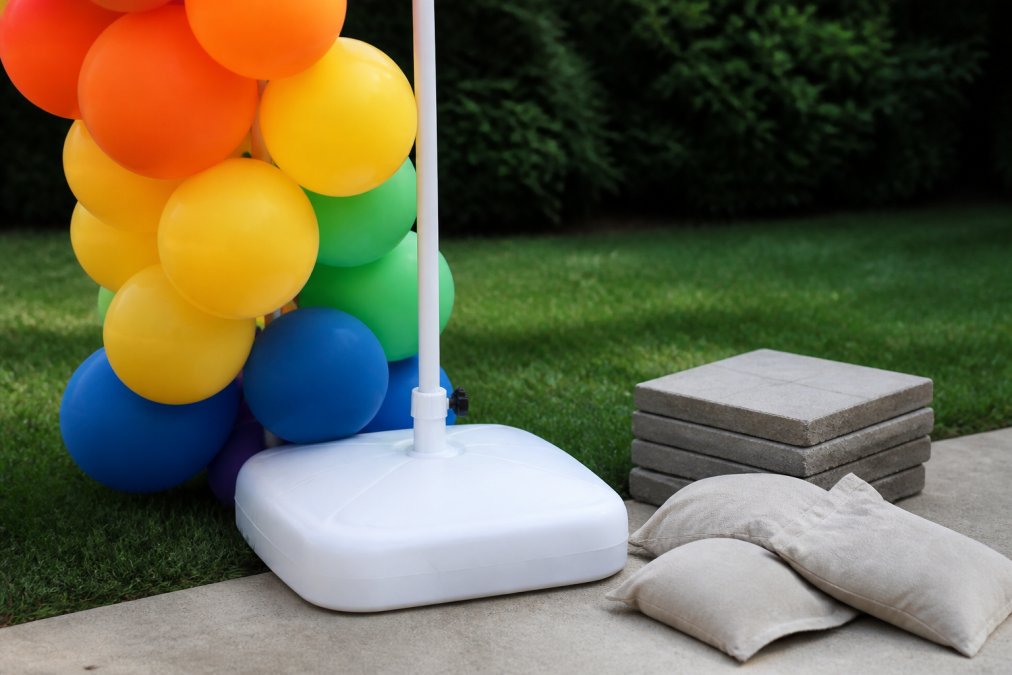
Water weights vs. sand weights vs. paver bases
Each anchoring option solves a different problem. Here is how they compare:
| Anchor Type | Best For | Drawback | Setup Time |
|---|---|---|---|
| Water weights | Grass and turf, quick teardown | Leak risk, freeze risk | Fast |
| Sand weights | Windy sites, heavy hold | Bulky to transport | Moderate |
| Paver bases | Concrete and pavers | Heavy, may scratch surfaces | Slow |
| Ground stakes | Soft soil only | Useless on hardscape | Fast |
Material-specific anchoring: grass, concrete, decking, and gravel
Grass and turf. Ground stakes or auger-style anchors driven at a 45-degree angle away from the arch give the strongest hold, transferring pull into undisturbed soil. Pair each stake with a sandbag or water weight at the base plate so the frame cannot lift before the stake bites. On irrigated lawns, drive stakes deeper near sprinkler heads or switch to weights.
Sizing the anchor to the lift
Latex balloons expand with heat, increasing lift and strain on every anchor point. Build in a safety margin rather than anchoring to the exact weight of your installation. Installers commonly size total anchor mass well above the calculated lift, then add a secondary tether as insurance. The ratio depends on wind exposure and arch height, but the principle holds: the anchor should feel overbuilt for a calm day, because the day you need it is not a calm day.
U.S. Consumer Product Safety Commission balloon safety guidance
Step 3: Secure Balloon Stands, Frames, and Columns
Balloon stands, frames, and columns need two-point stabilization: a weighted base and a tether at the top. One without the other tips in a moderate breeze.
Work through these steps for each structure:
- Assemble the frame fully on the ground before adding balloons.
- Attach the base plate and load it with your chosen weight.
- Add a secondary tether from the top of the column to a stake or fixed object.
- Cover exposed framing with ribbon, fabric, or balloon clusters so no bare metal or plastic shows.
- Test the structure by pressing gently at the top, it should flex slightly, not tip.
Never anchor a balloon column to a folding table or a chair. Both are common choices and both are unstable. A single gust can take the table, the column, and anything on it in one motion.
Step 4: How to Prevent Balloons From Popping in the Sun
To prevent balloons from popping in the sun, under-inflate them and keep the installation out of direct heat. Thermal expansion is the leading cause of daytime balloon failure outdoors. A balloon filled to full capacity in a cool morning will stretch past its limit by midday. Fill to roughly 80 to 90 percent of capacity, leaving a soft, slightly squishy feel, so the extra room absorbs expansion instead of tearing the latex.
Under-inflation is the single most effective, lowest-cost way to extend outdoor balloon longevity. It costs nothing and prevents the most common failure mode.
Step 5: Manage Wind Resistance and Weather Conditions
Wind resistance is managed by reducing surface area, lowering height, and anchoring at multiple points. No single trick beats a broadside gust. Practical moves that work:
- Lower the installation. A tall arch catches more wind than a low one. Bring the peak down where the design allows.
- Break up large surfaces. Balloon netting over a wide span acts like a sail. Divide it into smaller, separately anchored sections.
- Anchor every end and every joint. A garland anchored only at two ends whips in the middle.
- Watch the forecast. Sustained wind above a light breeze is a signal to reconsider the setup entirely.
Reading the forecast like an installer
The number that matters is not average wind speed, it is the gust. A light-breeze day with gusts into the teens stresses a tall arch far more than steady moderate wind, because gusts apply sudden lateral load a slack tether cannot absorb. Check the hourly forecast and the gust column. If gusts climb through your setup and event window, lower the design, add anchors, or move the installation to a sheltered side of the building.
Emergency repair kit for high-wind events
This is the difference between a display that survives a gust and one that ends up in a neighbor’s yard. Build a kit before the event and keep it within arm’s reach, not in the car:
- Spare balloons in every size and color used, pre-sorted so you are not digging through a bag mid-event
- Extra ribbon and tether line, cut to length in advance
- Clips and balloon tape for re-securing clusters that have shifted
- A hand pump, a popped balloon replaced by mouth is a balloon replaced badly
- Sandbags or water weights as backup ballast if a primary anchor fails
- A small towel for drying surfaces before re-applying tape or adhesive
- Scissors and a trash bag for fast, clean removal of failed components
Contingency planning and teardown triggers
Decide teardown triggers in advance and write them down so you are not making the call with guests watching. Set two thresholds: “reinforce and continue” and “take it down.” Reinforce when gusts are noticeable and the arch flexes more than a slight sway; take it down when the structure visibly leans, anchors drag, or lightning is within a reasonable distance.
National Weather Service wind advisory criteria
How Long Does Outdoor Balloon Decor Last?
Outdoor balloon decor typically lasts four to eight hours in good conditions and less in direct sun or wind. Latex balloons oxidize and dull within hours, turning matte before the balloon actually fails.
Variables that shorten or extend that window:
- Direct sun: accelerates oxidation and thermal expansion
- Wind: stresses anchor points and ribbon knots
- Humidity: generally neutral for latex, but hard on adhesives
- Shade and under-inflation: the two biggest extenders
Common Mistakes to Avoid
- Anchoring only at the ends. Mid-span sag and whip are the result.
- Filling balloons to full size. Thermal expansion has nowhere to go.
- Skipping the repair kit. A popped balloon mid-event with no spare is a visible gap in every photo.
- Setting up on a hard, hot surface. Pavement radiates heat and shortens balloon life.
- Forgetting cleanup and disposal. Latex fragments and ribbon scraps are a litter problem and, on some public properties, a permitting issue. Check with the venue about disposal rules before the event.
Build an emergency repair kit before the event: spare balloons in each size and color, extra ribbon, clips, a hand pump, and a small towel. A two-minute fix beats a two-hour gap in your display.
If you would rather not manage anchors, weights, and weather windows on your event day, RI Party Store offers professional setup for balloon décor and event rentals, backed by a friendly local team and clean, dependable equipment. Explore our balloon décor and rental options, or stop by for in-store pickup. Get started with RI Party Store and let our team handle the anchoring so you can enjoy the celebration.
Frequently Asked Questions
How do you keep balloon arches from blowing away outside?
Secure outdoor balloon decor with weighted bases that match the arch size. Water-weighted bases, sandbags, or paver stones all work. Push stakes into grass for extra hold, or use sandbags on concrete. Tether the top of tall arches to a fixed point like a fence post or railing with fishing line. Check wind forecasts before setup and bring the arch indoors if gusts are too strong.
What is the best way to weight outdoor balloon garlands?
For balloon garlands, attach base plates at each anchor point and load them with water weights or sand. On grass, combine weights with ground stakes for a double hold. On pavement, use sandbags or heavy pavers. Never rely on tape or suction cups alone outdoors. For elevated garlands on fences or railings, zip-tie the garland to the structure and add a weight at the lowest point to reduce swinging.
Can balloon decor survive high winds?
Standard latex balloon decor can handle breezes if properly anchored. For strong winds, use a balloon netting or cover, reduce the height of your display, and add extra weights. If severe weather is forecast, plan an indoor backup or delay setup. Balloon columns and arches catch more wind than single balloons, so anchor them securely and tether tops when possible.
How long does outdoor balloon decor last?
Outdoor balloon decor typically lasts for several hours in mild weather. Heat and direct sun accelerate oxidation and popping, so morning setups for afternoon events work best. Shade and under-inflation extend lifespan significantly.