
DIY Engagement Party on a Budget: 2026 Guide
Last Updated: October 22, 2026
Quick Summary
To plan a DIY engagement party on a budget, set your total budget and guest list first, then divide the money across food, drinks, decor, rentals, and paper goods before sending invitations. A 20-guest at-home party with a $1,200 budget works out to about $60 per guest, and guest count is the biggest lever on total cost.
- A small at-home gathering for 10 to 25 guests is the sweet spot for staying affordable.
- Spend on what guests remember, like food, photos, and the toast, and save on what they forget.
- Every additional 10 guests adds roughly $300 to $700 at the mid tier.
- Start your planning checklist six to eight weeks out and work backward from the event.
- Calculate per-guest quantities before shopping, since waste quietly blows most DIY budgets.
Table of Contents
- Start With a Realistic Engagement Party Budget Breakdown
- Your Engagement Party Planning Checklist, Six to Eight Weeks Out
- DIY Engagement Party Decorations That Look Expensive
- Engagement Party Food Ideas on a Budget
- Shopping Quantities, Bulk Buying, and Waste Reduction
- Weather, Accessibility, and Day-of Contingency Planning
- Conclusion
- Frequently Asked Questions
Start With a Realistic Engagement Party Budget Breakdown
Most engagement party budgets fail because people plan the guest list before the money. Flip that order: set a total you can actually spend, then divide it across food, decor, drinks, and rentals before any invitation goes out.
A small at-home gathering for 10 to 25 guests is the sweet spot for staying affordable, and Paperlust’s 2026 engagement party planning guide puts that kind of DIY party in a modest range compared with a full catered event.
Here is the core principle behind every budget-friendly DIY engagement party: spend on what guests remember, save on what they forget. People remember the food, the photos, and the toast. Nobody remembers the napkin color.
Line-Item Cost Ranges for a Small At-Home Party
Treat these as percentage targets, since totals depend on guest count and menu:
- Food: the largest share, whether you cook, potluck, or cater part of the menu
- Drinks: beer, wine, and a signature batch cocktail cost far less than a full bar
- Decor: DIY florals, string lights, and signage eat a smaller slice
Write your own numbers into a spreadsheet and price each line before you buy anything.
A Sample Budget That Adds Up
Here is a worked example for a 20-guest at-home engagement party with a $1,200 total budget. These are planning ranges, not quotes; local prices vary.
| Category | Share | Dollar Range | What It Covers |
|---|---|---|---|
| Food | 35% | $420 | Two hearty mains, two sides, dessert; some potluck help |
| Drinks | 15% | $180 | Beer, wine, one batch cocktail, water and lemonade |
| Decor | 15% | $180 | Grocery-store florals, string lights, photo wall supplies |
| Rentals | 15% | $180 | Tables, chairs, linens; tent only if needed |
| Paper goods | 8% | $96 | Plates, cups, napkins, invitations, photo printing |
| Contingency | 12% | $144 | Ice, batteries, last-minute runs, damage buffer |
| Total | 100% | $1,200 |
That works out to about $60 per guest. At 30 guests, the same math pushes the total to roughly $1,800 unless you cut a category. Guest count is the single biggest lever on total cost.
Adjustable Spending Tiers
Build your plan around one of three tiers.
- Lean (about $30 to $40 per guest): Potluck mains, BYOB drinks, borrowed tables and chairs, grocery-store florals in saved jars, digital invitations. Skip rentals entirely if you can borrow.
- Mid (about $50 to $70 per guest): You cook the mains, provide beer and wine, rent tables and chairs, and buy a modest floral order. This is the most common DIY range.
- Comfortable (about $80 to $100 per guest): Add a tent or heater, a larger floral budget, and a catered side or dessert. Still far below a fully catered event.
Where to Splurge and Where to Cut
Splurge on what guests photograph: the food table, florals, and backdrop. Cut hard on disposable plates, printed menus, and party favors.
Trade-offs to weigh before you commit:
- Guest count vs. menu: Every additional 10 guests adds roughly $300 to $700 at the mid tier. Trimming the list is the fastest way to protect your food budget.
- Venue vs. rentals: A backyard is free but may need tables, chairs, and a tent. A borrowed community room may include seating and cost less overall once rentals are counted.
- DIY vs. bought: DIY decor saves money only if you already own the tools and have the time. Price the materials before you commit to a project.
Buy plain white plates and upgrade them with a single ribbon or a stamped initial. It reads as intentional design for a fraction of the cost of themed tableware, and white works with any color scheme.
Set the total first, divide it by guest count to get a per-person target, then assign dollar ranges to each line. A budget that adds up on paper is the only one that survives the store.
Your Engagement Party Planning Checklist, Six to Eight Weeks Out
An engagement party planning checklist starts six to eight weeks out and works backward from the event, giving you time to book rentals, order invitations, and shop sales without panic-buying the week of.
The biggest mistake is starting too late: last-minute hosts pay full price and settle for whatever is left on the shelf.
Here is a working checklist to copy:
- Eight weeks out: Set your total budget and draft the guest list
- Seven weeks out: Pick the date, time, and venue
- Six weeks out: Send invitations and book any rentals
Choosing a Date, Time, and Guest List
Avoid holiday weekends, when rentals cost more and guests travel. A Saturday afternoon or early evening works best at home: less lighting and fewer hours of food service.
Keep the guest list to your inner circle: smaller is easier, cheaper per head, and more relaxed. Send digital invitations to save on printing and postage, and track RSVPs in one shared spreadsheet so you know your real headcount before you shop.
A Dated Checklist From Decision to Cleanup
This dated version turns the weekly list into a usable plan. Adjust the dates to your event day and print it.
| When | Task | Owner |
|---|---|---|
| 8 weeks out | Set total budget; draft guest list; pick two date options | Host |
| 7 weeks out | Confirm date, time, and venue; check rental availability | Host |
| 6 weeks out | Send invitations; book rentals; reserve any tent or heater | Host |
| 5 weeks out | Choose theme and color palette; sketch decor plan | Host + helper |
| 4 weeks out | Finalize menu; list DIY projects and materials; price them | Host |
| 3 weeks out | Order or buy decor supplies; confirm potluck contributions | Helper |
| 2 weeks out | Buy non-perishables, drinks, and paper goods in bulk | Host |
| 10 days out | Confirm RSVPs; finalize headcount for quantities | Host |
| 1 week out | Build decor; prep make-ahead food; print photos | Helper |
| 3 days out | Shop fresh food; test lights and outlets | Host |
| Day before | Set up tables, hang lights, chill drinks, prep serving dishes | Helper |
| Morning of | Arrange florals; set food table; fill water station | Helper |
| 1 hour before | Put out perishable food; light candles; final walk-through | Host |
| After the party | Pack rentals for return; store reusable decor; send thanks | Host |
Day-of Setup Timeline
A written timeline keeps setup from spilling into party time. For a 4 p.m. start, work backward:
- 8 a.m.: Pick up any rentals or last-minute items; set out tables and chairs.
- 10 a.m.: Hang string lights and the photo wall; test every connection.
- 11 a.m.: Arrange florals and set the food table with empty serving dishes.
Assign one helper to each task block. A two-person setup crew cuts the morning in half.
Print the dated checklist and the day-of timeline and tape them inside a kitchen cabinet. A plan you can see gets followed; a plan in your phone gets buried under texts.
The checklist is not the point; the dated schedule is. Work backward from your start time, assign an owner to every block, and give yourself a hard stop one hour before guests arrive.
DIY Engagement Party Decorations That Look Expensive
DIY engagement party decorations look expensive when you repeat one idea instead of scattering ten. One strong element repeated down a table or across a wall reads as design; a pile of mismatched crafts reads as clutter.
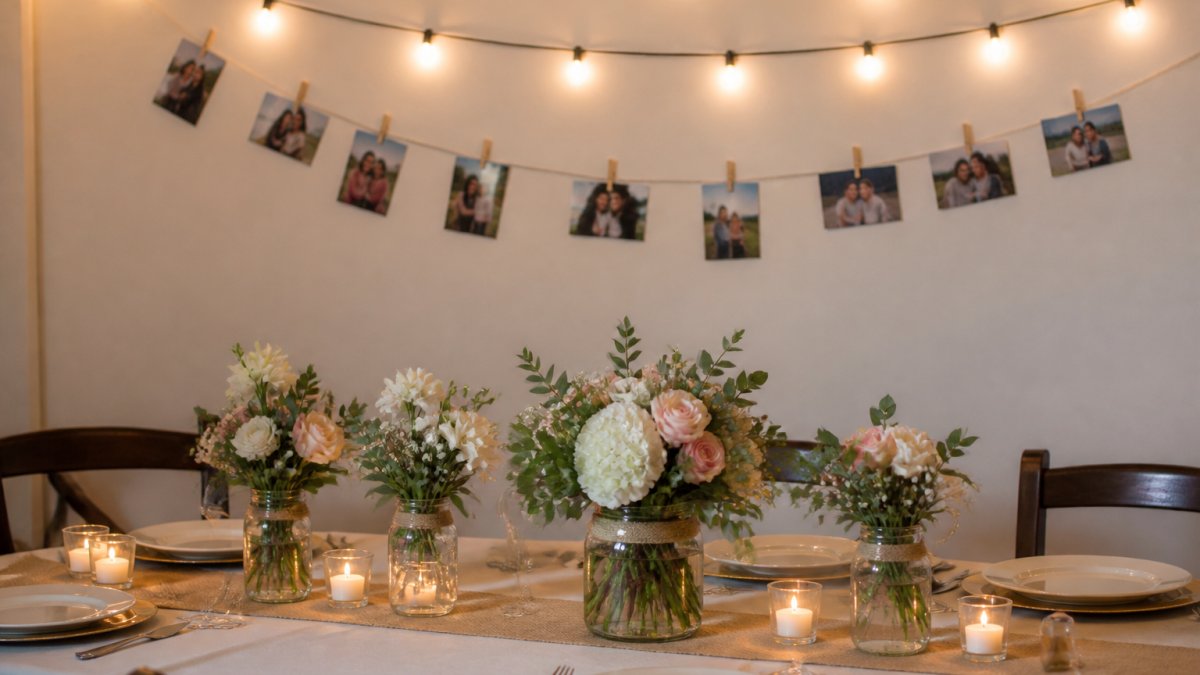
Three Projects You Can Finish in a Weekend
These three projects deliver the most impact for the least money and time:
- Repurposed jar florals. Save glass jars for a few weeks, then fill them with grocery-store blooms split into smaller bunches. One creator who DIYed an engagement party documented making six floral arrangements with about $200 in materials, which shows how far a modest floral budget stretches when you arrange it yourself.
- A photo-and-twine wall. Print favorite couple photos at a drugstore, clip them to twine with mini clothespins, and hang the strands against a blank wall. It doubles as a conversation piece and a photo backdrop.
- String-light canopy. Drape warm-white string lights across the yard or ceiling in a zigzag. The lighting alone transforms a plain space after dark.
Skip helium balloons outdoors unless you weight them properly. A gust takes an unweighted bunch instantly, and you lose the money and the look. Anchor every balloon to a weighted base or use an arch kit.
Engagement Party Food Ideas on a Budget
Engagement party food ideas on a budget follow one rule: serve a few things done well rather than many done cheaply.
Build the menu around make-ahead dishes: slow-cooker pulled pork, a pasta bake, or a taco bar feeds a crowd for little per head and preps the day before.
For drinks, set up a self-serve station with beer, wine, and one batch cocktail or pitcher of sangria, skip the full bar.
Shopping Quantities, Bulk Buying, and Waste Reduction
Shopping quantities and bulk buying are where DIY hosts save real money or waste it. Calculate per-guest amounts before you walk into the store, then buy to that number.
Use these planning figures as a starting point:
| Item | Plan Per Guest | Notes |
|---|---|---|
| Appetizer bites | 4 to 6 pieces | More if no full meal is served |
| Main protein | 6 to 8 oz | Less if sides are heavy |
| Side dishes | 2 to 3 servings | One starch, one vegetable, one salad |
| Drinks | 2 to 3 in first hour, then 1 per hour | Include plenty of water |
| Ice | 1 to 1.5 lb per person | More in warm weather |
| Plates and cups | 1.5x guest count | Covers breakage and seconds |
Buy shelf-stable items, drinks, and paper goods in bulk at warehouse stores like Costco, and buy fresh food close to the date. To cut waste, choose a menu with overlapping ingredients so parsley or lemons get used across several dishes instead of half going in the trash.
The cheapest party is the one you don’t overbuy for. Calculate per-guest quantities first, then shop to the list. Waste is the hidden line item that quietly blows most DIY budgets.
Weather, Accessibility, and Day-of Contingency Planning
Contingency planning separates a calm host from a frantic one. For an at-home or backyard party, always have a rain plan and a backup for anything that could fail.
Work through these before the day:
- Weather: Have a tent, canopy, or indoor fallback ready. Move the food table under cover regardless.
- Accessibility: Make sure paths are clear and firm, provide seating for guests who can’t stand long, and keep the food and drinks reachable for everyone.
- Rentals: Confirm delivery windows and setup times in writing, and know who to call if something arrives damaged.
This is where a local supplier earns its keep. RI Party Store offers in-store pickup, delivery, and professional setup on rentals, so equipment arrives clean and on time, a backup that matters when your venue window is tight.
Conclusion
The hosts who pull off a beautiful DIY engagement party on a budget aren’t the biggest spenders. They plan backward from a real number, repeat one strong decor idea, and buy to a per-guest list.
If you’d rather spend your energy on the toast than on hunting down tables and lights, RI Party Store can help. We stock party supplies, balloon décor, and event rentals under one roof, with delivery and professional setup across Rhode Island and Southeastern Massachusetts.
Frequently Asked Questions
How much should you spend on a DIY engagement party?
For a small at-home gathering of 10 to 25 guests, published planning estimates put the total at $200 to $800, according to a 2026 Paperlust planning guide. Most U.S. engagement parties overall run $1,000 to $5,000, so a DIY approach keeps you well below that range. Set your number before you buy anything, then assign it across food, drinks, decor, and invitations. Food and drinks usually take the biggest share, so protect that line first and let decorations flex around what is left.
How far in advance should you start planning an engagement party?
Six to eight weeks gives you enough runway to book a date, send invitations, and finish DIY projects without a last-minute scramble. Use the first two weeks to lock the guest list and budget, weeks three and four for invitations and decor shopping, and the final two weeks for food prep and setup. If you are hosting at home, confirm your backup space for rain during week one, not the day before. Starting early is the single biggest money saver because it lets you buy in bulk and catch sales.
Can you host your own engagement party?
Yes. Hosting your own engagement party is common, especially for a budget-friendly at-home celebration. You control the guest list, the menu, and the timeline, which makes it easier to keep costs down. If a parent or friend offers to help, hand off one specific task such as drinks or setup rather than the whole event. For DIY engagement party decorations, recruit two people for setup day so you are not hanging string lights alone an hour before guests arrive.
What food should you serve at a budget engagement party?
Build the menu around two or three make-ahead dishes plus a grazing table. A taco or pasta bar, a large salad, and a cheese and cracker spread feed a crowd for less than plated catering. Buy proteins and pantry staples in bulk at warehouse stores, and keep drinks simple with a signature cocktail, beer, wine, and a large batch of lemonade. Ask guests to bring a dessert if they offer. Plan roughly one and a half servings per person per dish so you are not tossing leftovers.