
Paw Patrol Bounce House Rental: Planning Guide
Table of Contents
- Why a Paw Patrol Bounce House Is the Centerpiece of a Kids Party
- Paw Patrol Bounce House Options: Standard vs. Combo Unit
- Inflatable Bounce House Space Requirements: Measure Before You Book
- Bounce House Rental Safety Guidelines Every Parent Should Know
- Rental Pricing, Delivery, and Booking Windows
- Kids Party Planning Checklist for a Themed Event
- Book Your Paw Patrol Bounce House with RI Party Store
- Frequently Asked Questions
Last Updated: September 5, 2026
Why a Paw Patrol Bounce House Is the Centerpiece of a Kids Party
A paw patrol bounce house transforms a backyard gathering into the adventure kids talk about for months. When the inflatable lands with Ryder and the pups front and center, children ages 2 to 12 immediately recognize their favorite rescue team, and the jumping area becomes the busiest spot on the lawn.
The real value is practical, not just visual. A single inflatable concentrates the energy of an entire guest list into one safe, contained space. Below, we walk through sizing, safety, booking windows, and the exact checklist to make sure your Paw Patrol theme lands without a hitch.
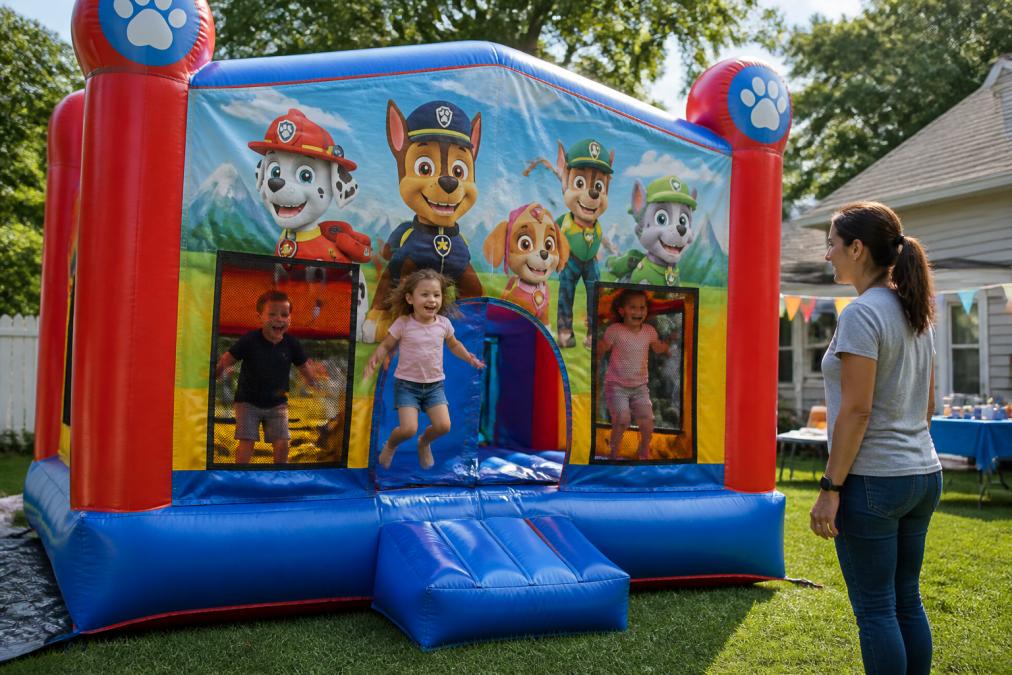
Paw Patrol Bounce House Options: Standard vs. Combo Unit
Choosing between a standard bounce house and a combo unit is the first major decision. The right choice depends on the age mix of your guests, the physical space you have, and the kind of energy you want to manage.
Standard Bounce House: The Controlled-Energy Choice
A standard unit focuses play into a single, contained jumping area, which simplifies supervision. Most standard Paw Patrol units are designed for children ages 2 to 8 with a weight capacity around 800 to 1,000 pounds, making them ideal for parties where the guest list skews younger (cpsc.gov).
- Best For: Toddler and early elementary birthdays, indoor gyms, or smaller backyards where a large footprint isn’t available.
- Supervision: Easier. All kids are in one visible zone, reducing the chance of a child wandering off.
- Play Pattern: High-energy but continuous. Kids jump, bounce, and tire themselves out without the need for a water source.
- Space: A standard unit typically requires a 15′ x 15′ footprint, but you should add a 5-foot safety perimeter on all sides, bringing the total clear area to roughly 25′ x 25′.
Combo Unit: The High-Impact, High-Planning Choice
A combo unit, often featuring a slide, climbing wall, or splash zone, offers varied activities that can hold the attention of a wider age range (3 to 12) for longer periods. However, it introduces variables that require more planning.
- Best For: Parties with a mix of older and younger kids, summer events where water play is a plus, or when you want the inflatable to be the undisputed main event.
- Supervision: More demanding. You now have multiple zones (jumping, sliding, landing pool) that need eyes on them. You may need two supervising adults.
- Play Pattern: Stop-and-go. Kids climb, slide, bounce, and repeat. This creates natural ‘lines’ and can lead to bottlenecks at the top of the slide if not managed.
- Space: A combo unit with a slide needs a larger footprint, often 20′ x 20′ or more. With the safety perimeter, you’re looking at a 30′ x 30′ clear area. You also need a hose bib within reach for wet operation.
The Decision Matrix: Which One Fits Your Party?
To make the call, ask yourself three questions:
- What is the age range of the majority of guests? If most are under 6, a standard unit is safer and more engaging. If you have a split between 4-year-olds and 10-year-olds, a combo unit gives the older kids a challenge (the slide) while the younger ones can stick to the bounce area.
- What is your supervision plan? A standard unit requires one dedicated adult. A combo unit, especially in wet mode, requires two. If you don’t have a second responsible adult, the standard unit is the safer operational choice.
- What is your cleanup tolerance? Dry units are a 10-minute wipe-down. Wet units require draining, drying, and a more thorough sanitization process to prevent mildew. If you’re hosting back-to-back events or don’t have time to manage the drying process, a dry standard unit is more practical.
Why This Comparison Matters for Your Party Flow
The choice between standard and combo isn’t just about features; it’s about the arc of your party. A standard unit creates a high-intensity burn phase, kids jump for 60-90 minutes, then they’re ready for cake and presents. A combo unit can sustain interest for 2-3 hours, which is better for a longer event window but requires more active supervision.
Parents often book a standard unit for a party that starts mid-afternoon and ends with dinner, while combo units are booked for all-day summer events where the water feature is the central attraction. Matching the unit type to your party’s timeline is just as important as matching it to your yard’s dimensions.
Inflatable Bounce House Space Requirements: Measure Before You Book
Before you fall in love with a specific unit, grab a tape measure and check your yard. Inflatable bounce house space requirements are the most common reason bookings fall through. You need a flat, level area clear of rocks, sticks, and overhead branches, with enough room for the unit itself plus a safety perimeter on all sides.
A standard bounce house generally fits a footprint of roughly 15 by 15 feet, while a combo unit with a slide can stretch to 20 by 20 feet or more. Add at least 4 to 5 feet of clearance around the entire inflatable so kids do not collide with fences, furniture, or trees. You also need a standard electrical outlet within 100 feet for the continuous blower, and if you are renting a wet unit, a hose bib within reach. When in doubt, measure twice and send the numbers to your rental company before you confirm; it saves a same-day headache.
Skipping the yard measurement is the fastest way to cancel a party. If the unit does not fit, or the ground is too sloped or wet, the rental crew cannot set it up safely, and you are left with disappointed kids and no centerpiece.
Bounce House Rental Safety Guidelines Every Parent Should Know
Rental companies are responsible for providing safe equipment, but the final line of defense is you. Most safety incidents are preventable with a simple pre-event inspection and a clear operational plan.
The Pre-Setup Inspection: What to Check Before the Crew Leaves
When the delivery crew arrives, walk the perimeter with them before they anchor the unit, this is your window to catch issues while there’s still time to swap the unit.
- Vinyl Condition: Run your hand along the interior floor and walls. You’re feeling for tacky spots (which indicate a patch) or rough edges (which indicate a tear). Ask the crew to point out any existing patches. A few patches are normal, but a unit with multiple patches in the high-impact zones may have weakened seams.
- Seam Integrity: Look at the seams where the walls meet the floor. These are the highest-stress points. Check for any separation or fraying threads. A unit with failing seams is a deflation risk.
- Blower and Airflow: Confirm the blower is running at full power. The unit should feel firm to the touch. If you can easily push a dent into the wall, the airflow is insufficient. Also, check that the blower intake is clear of debris and that the power cord is a heavy-duty gauge (at least 14-gauge) for the distance it’s running.
- Anchoring System: Count the stakes. A standard unit should have at least 6-8 stakes, and a combo unit should have 10-12. The stakes should be driven flush with the ground. If the crew is using sandbags instead of stakes (common for artificial turf), ensure they are rated for the unit’s size and are placed at every anchor point.
The Operational Safety Briefing: Setting Rules with Parents, Not Just Kids
A critical mistake is only briefing the children. The adults staying for the party need to know the rules too, because they will be supervising when you’re inside getting the cake ready.
- The Capacity Rule: The ‘6-8 kids’ rule is a guideline, but the real rule is about weight and size. A safe load is roughly 2-3 kids per 100 square feet of bounce floor (the CDC). More importantly, enforce a strict size separation. If you have a 10-year-old and a 3-year-old, they should not be in the unit at the same time. This is the single most common cause of injury.
- The No-Flip Rule: Somersaults and flips are the leading cause of neck injuries in inflatables (PubMed). This rule is non-negotiable. State it clearly to the kids and remind the supervising adults to enforce it.
- The Wind Policy: The 15-20 mph wind limit is a hard stop. If you feel a gust that lifts the fabric even slightly, get the kids out immediately. Do not wait for the rental company to call you. You are the on-site decision maker.
The Post-Event Walkthrough: Protecting the Deposit
When the crew arrives for teardown, do a quick walkthrough with them. Note any new tears or issues that occurred during the party. This protects your security deposit and ensures you’re not held responsible for pre-existing damage. A simple photo of the unit before and after can save a dispute.
The Parent’s Safety Checklist: A Quick Reference
| Checkpoint | Action | Why It’s Critical |
|---|---|---|
| Pre-Setup | Inspect seams, vinyl, and blower power | Identifies structural weaknesses before kids are at risk |
| Anchoring | Count stakes and confirm they’re flush | Prevents the unit from shifting or lifting |
| Size Separation | Group kids by similar age/size | Prevents high-impact collisions from height mismatches |
| Rule Briefing | Brief parents, not just kids, on no-flips and capacity | Ensures consistent enforcement when you’re not present |
| Wind Monitor | Designate an adult to watch for gusts | Enables immediate evacuation if wind exceeds safe limits |
| Post-Event | Document damage with photos | Protects your deposit and clarifies liability |
This checklist is designed to be run in under 10 minutes. It turns you from a passive observer into an informed host who has done everything possible to create a safe environment.
Rental Pricing, Delivery, and Booking Windows
Rental pricing for a paw patrol bounce house depends on the unit type, the day of the week, and your delivery location, so request a quote rather than assume a flat rate. Combo units with water slides generally cost more than standard bounce houses, and weekend bookings during peak season from May through September fill quickly. Bundling the inflatable with other party equipment, like tables, chairs, or a foam machine, improves the overall value.
Popular Paw Patrol units, especially combo units for summer parties, often reserve out two to three weeks in advance. Delivery and setup are handled by the rental crew, who arrive before the party start time, anchor the unit, and confirm the blower is running. Plan for the crew to return after the event for teardown, and confirm your venue window allows for both arrival and pickup. For the most accurate pricing and availability for your date, check current inventory and rates directly with your local provider.
Kids Party Planning Checklist for a Themed Event
A themed Paw Patrol party comes together smoothly when you build your kids party planning checklist around the inflatable as the anchor.
- Book the unit 2-3 weeks out and confirm delivery and pickup windows with the venue
- Measure the yard and confirm a power outlet and water source (for wet units)
- Send a clear invitation with start and end times so guests arrive in waves
- Plan a backup for weather and know your rental company’s rain policy
- Set up a snack station away from the inflatable to keep food and drinks off the vinyl
- Assign a supervising adult in shifts so the entrance is never unattended
- Order themed décor like Paw Patrol balloons, tableware, and a cake topper
- Prep a lost-and-found bin and label water bottles with names
Schedule the bounce house time for the first 90 minutes of the party. Kids arrive with maximum energy, and you can transition to cake and presents while they are tired and happy, which makes the cleanup zone much easier to manage.
Book Your Paw Patrol Bounce House with RI Party Store
RI Party Store makes the rental process straightforward for families across Rhode Island and Southeastern Massachusetts. As a locally owned, customer-focused shop, we provide high-quality, clean inflatables along with the full range of party supplies, from themed tableware to balloon décor, so you can plan everything under one roof. Our team handles professional delivery and expert setup, arriving with the equipment anchored and ready before your first guest shows up.
Parents in our service area consistently tell us the experience is dependable from start to finish. One reviewer, Rosie Silva, noted that her family booked a third bounce house because the service is “just that good,” and Mark Duffy echoed that sentiment, calling the process “a great experience.” We anchor our reputation on clean equipment, on-time delivery, and a friendly team that treats your kid’s party like our own event.
Frequently Asked Questions
How much space do I need for a Paw Patrol bounce house rental?
A standard Paw Patrol bounce house typically needs a flat area of about 15 by 15 feet, while larger combo units with slides need up to 20 by 20 feet. You also need about 2 feet of clearance on each side and at least 10 feet of overhead space free from tree branches or power lines. Always measure your yard before booking and confirm the exact dimensions with your rental company.
What safety guidelines should I follow during the party?
Follow the weight limit and capacity rules posted on the unit, which for most Paw Patrol bounce houses is around 6 to 8 children at once. Keep kids of similar sizes together and remove shoes, glasses, and jewelry before they enter. A responsible adult must supervise at all times, and the unit must be properly anchored with stakes or sandbags. Keep the blower clear and never move the bounce house while children are inside.
How far in advance should I book a themed bounce house?
For a Paw Patrol bounce house, book at least 2 to 3 weeks in advance, especially during peak party season from May through September. Weekend slots fill quickly, and themed units are limited in quantity. If you are planning a party during a holiday weekend or school vacation, book 4 to 6 weeks ahead to guarantee availability for your date.
Can a Paw Patrol bounce house be used indoors?
Yes, a Paw Patrol bounce house can be set up indoors if you have a space with a ceiling height of at least 12 feet and enough floor area for the unit plus clearance on all sides. The venue needs access to a standard electrical outlet for the blower. Check with your rental company about indoor setup requirements, as some units are designed for outdoor use only.
Planning a kids party does not have to be stressful, but it does require attention to space, safety, and timing. Let us handle the heavy lifting with clean, professionally delivered inflatables and all the themed supplies you need in one stop. Get started with RI Party Store and turn your backyard into Adventure Bay this weekend.
This article was written using GrandRanker