
Table of Contents
- Planning a Wedding for 150 Guests: The Complete Framework
- Average Wedding Cost for 150 Guests and Budget Allocation
- Wedding Catering Cost Per Person and Menu Planning
- Venue Selection: Capacity and Square Footage Requirements
- Wedding Seating Chart Templates and Table Layouts
- How to Cut Your Wedding Guest List Without Regret
- Transportation, Logistics, and Timeline for 150 Guests
- Sustainability and Post-Wedding Budget Reconciliation
Last Updated: August 15, 2026
Planning a Wedding for 150 Guests: The Complete Framework
Planning a wedding for 150 guests requires balancing budget, logistics, and guest experience. A 150-guest wedding sits at an inflection point where decisions about venue, catering, seating, and timeline ripple through every other choice you’ll make.
This guide covers budget allocation, catering logistics, venue capacity, seating strategies, and practical details that separate smooth weddings from chaotic ones. The good news: 150 guests is large enough to negotiate vendor pricing but small enough to execute with a tight team.
Average Wedding Cost for 150 Guests and Budget Allocation
Most couples allocate their budget across six major categories: venue, catering, photography/videography, florals and décor, entertainment, and miscellaneous items. The percentages shift based on priorities, a couple prioritizing an exceptional venue might allocate 30% there, while another focused on food might spend 40% on catering.
The challenge with 150 guests is that fixed costs (venue rental, photographer day rate) don’t scale linearly with headcount, but catering costs scale almost directly with guest count.
Percentage Breakdown by Category
A realistic percentage breakdown for a 150-guest wedding typically looks like this:
- Venue: 20-25%
- Catering and beverages: 35-40%
- Photography and videography: 8-12%
- Florals, centerpieces, and décor: 8-10%
- Entertainment, music, DJ: 5-8%
- Rentals (tables, chairs, linens, dance floor): 5-8%
- Invitations, favors, programs: 2-3%
- Contingency and miscellaneous: 5-10%
Per-person costs vary significantly by region and season. Fall and spring weddings typically cost 15-25% less than summer peak season. Friday and Sunday events negotiate better rates than Saturday.
Hidden Fees and Contingency Planning
Every vendor category has hidden fees. Caterers add service charges (18-22%) and gratuity expectations (15-20% additional). Venues charge setup and breakdown fees or require preferred vendors. Rental companies add delivery and setup fees.
Budget 8-12% of your total for contingencies. This buffer absorbs vendor price increases, last-minute additions, or service failures. Document every fee in writing and request itemized quotes that break down base cost, service charges, gratuity, delivery, setup, and taxes separately.
Wedding Catering Cost Per Person and Menu Planning
Catering costs dominate the budget at a 150-guest wedding, typically 35-40% of total spend. At this scale, economies of scale mean your per-person cost may be lower than smaller weddings, but your total catering bill will be your largest single expense.
Menu selection, service style, beverage package, and dietary accommodations all influence the final per-person cost.
Plated Dinners vs. Buffet Service
Plated dinners offer a more formal experience and precise portion control. Servers deliver prepared plates to guests, requiring more labor and coordination. Plated service typically costs 15-25% more per person than buffet but creates a more polished feel.
Buffet service is more casual and flexible. Guests serve themselves, reducing labor costs and allowing customization. Buffet works well for less formal weddings or when guests have varying dietary preferences. For a 150-guest wedding, buffet typically costs 10-20% less per person than plated service.
A hybrid approach, passed appetizers during cocktail hour, then a plated entrée, balances cost and experience.
Beverage and Gratuity Calculations
Beverages are a separate line item and major cost driver. A full open bar costs more than beer and wine only, which costs more than a signature cocktail plus beer and wine.
Gratuity expectations typically run 18-22% of the food and beverage subtotal, separate from any service charge. A $6,000 catering bill with 20% gratuity adds $1,200.
For planning purposes, estimate 2.5 alcoholic drinks per guest over a 4-5 hour reception. At 150 guests, that’s 375 drinks. Calculate your beverage cost based on your caterer’s bar package.
Venue Selection: Capacity and Square Footage Requirements
Choosing a venue for 150 guests requires understanding both stated capacity and actual usable space. A venue that "holds 200" might accommodate 200 for a standing cocktail reception but only 150 for a seated dinner.
Venue selection is the second-largest budget item and constrains everything else, it determines date options, catering company, décor limitations, and overall tone.
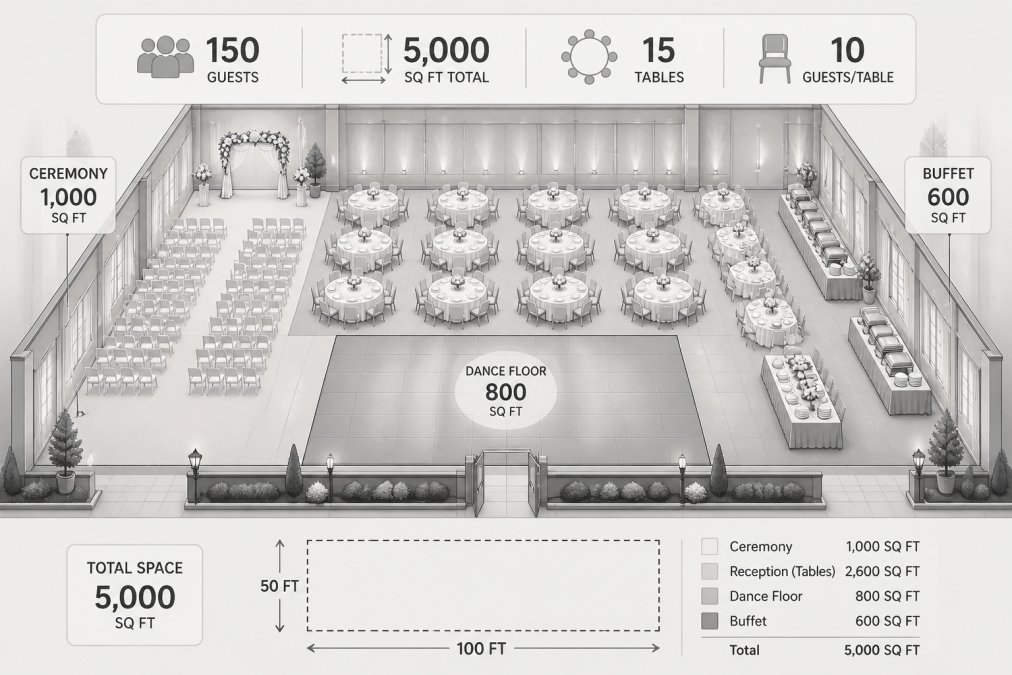
Calculating Space Needs for Ceremony and Reception
A ceremony space needs roughly 7-8 square feet per guest for seating. For 150 guests, that’s approximately 1,050-1,200 square feet.
Reception space requires significantly more square footage:
- Seated dinner with dance floor: 10-12 square feet per guest for tables and chairs, plus 100-150 square feet for a dance floor, plus 200+ square feet for bar, cake table, and DJ area. Total: roughly 1,700-1,900 square feet.
- Cocktail reception with high-top tables: 5-7 square feet per guest. Total: roughly 750-1,050 square feet.
- Buffet-style dinner: 8-10 square feet per guest plus buffet table space. Total: roughly 1,400-1,600 square feet.
Walkthrough the venue with your caterer and physically lay out table placement. Don’t rely on the venue’s capacity estimate alone.
Venue Types and Peak vs. Off-Peak Pricing
Venue types vary widely in cost and logistics. Hotel ballrooms offer built-in catering and climate control but often require preferred vendors. Barns or outdoor spaces offer character but require renting tables, chairs, linens, and lighting. Restaurants or private clubs offer food service but limited customization.
Peak season (May through October, especially June) commands 20-30% premium pricing compared to off-season. Negotiating venue pricing is possible, especially for off-peak dates or weekday events.
Wedding Seating Chart Templates and Table Layouts
A seating chart for 150 guests is logistically complex but essential. Strategic seating encourages conversation, separates conflicting personalities, and sets the tone for the evening.
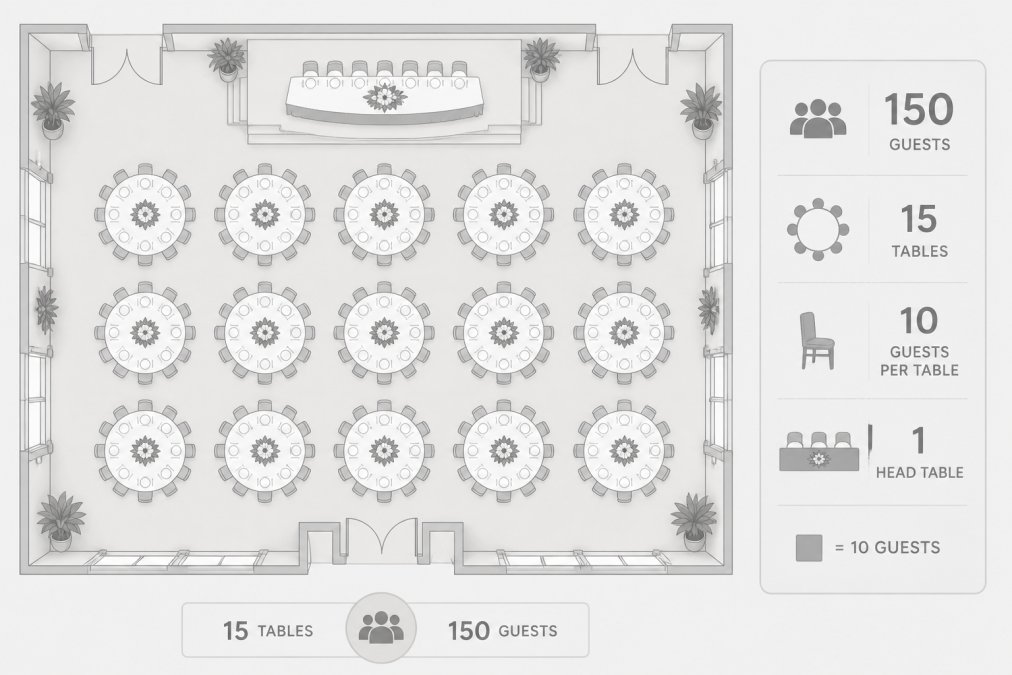
Round tables seat 8-10 people and encourage conversation. Rectangular tables seat 10-12 and work well for longer spaces. For 150 guests divided by 8 per table, you need roughly 19 tables. Divided by 10 per table, you need 15 tables.
Table Configurations and Guest Flow
Round tables are the standard for weddings because they facilitate conversation and feel intimate. A 60-inch round table seats 8-10 comfortably; a 72-inch round table seats 10-12. Space between tables should be at least 3-4 feet to allow servers and guests to move freely.
Position the dance floor centrally and visibly. The bar should be positioned away from the main entrance but visible and accessible. The cake table and gift table should be positioned where guests can see them but out of main traffic flow.
Managing Dietary Requirements and RSVP Data
Include a dietary restriction question on your RSVP card or wedding website. Common categories: vegetarian, vegan, gluten-free, shellfish allergy, nut allergy, kosher, and halal.
Create a spreadsheet with guest names, table assignments, dietary restrictions, and plus-one information. Share this with your caterer at least 2 weeks before the wedding.
At a 150-guest wedding, expect 15-25% of guests to have some restriction. Plan your menu to accommodate these without requiring special meals for everyone. Set a hard RSVP deadline 4 weeks before the wedding and a final count deadline 2 weeks before.
How to Cut Your Wedding Guest List Without Regret
Most couples start with a wish list of 200+ people and realize they can’t afford or accommodate them all. The decision process matters because how you cut determines whether guests feel excluded or understand the constraint.
Strategic Guest Reduction and Communication
Categorize guests: immediate family, extended family, close friends, work colleagues, and acquaintances. Be honest about who you actually want at your wedding versus who feels obligatory.
A common framework: invite immediate family and close friends, then add extended family and work colleagues only if budget allows. This creates a clear rule that’s easier to explain.
Communicate transparently: "We’re keeping our wedding intimate at 150 guests due to venue capacity" is more acceptable than appearing to have arbitrarily excluded someone. Don’t invite guests to the ceremony but not the reception, this creates a two-tier guest list that feels exclusionary.
Transportation, Logistics, and Timeline for 150 Guests
Coordinating 150 guests requires detailed planning. The typical wedding day timeline looks like this:
- 2 hours before ceremony: Venue opens, guests arrive, seating begins
- Ceremony: 20-30 minutes
- Cocktail hour: 45-60 minutes (while photos are taken)
- Reception begins: Guests enter, receive drinks, find seats
- Dinner service: 60-75 minutes
- Toasts and cake cutting: 30-45 minutes
- Dancing and mingling: 2-3 hours
- Last dance and send-off: 15-20 minutes
This timeline assumes a 5-6 hour reception. Parking and arrival logistics matter at this scale. If your venue has limited parking, arrange valet service or suggest rideshare.
Vendor Coordination and Day-of Execution
Coordinate with all vendors 2-3 days before the wedding. Confirm arrival times, setup requirements, and contact information. Create a day-of timeline and share it with the caterer, photographer, DJ, florist, and other vendors.
Assign a point person (wedding planner, trusted friend, or family member) to manage the timeline on the day of the wedding. This person coordinates vendor arrivals, confirms the ceremony start time, and signals the DJ for key moments.
Create a written timeline and distribute it to all key people the day before the wedding, including vendor names, phone numbers, and specific times.
Contingency Planning and Accessibility
Weather contingencies are essential for outdoor or semi-outdoor venues. Have a rain plan: move the ceremony indoors, set up tents, or reschedule.
Confirm your venue has accessible parking, accessible restrooms, and accessible pathways. If your venue has steps or uneven terrain, arrange for assistance or alternative routes.
Confirm with the caterer that they’ve prepared separate meals for guests with dietary restrictions and that servers know which guests get which meals.
Sustainability and Post-Wedding Budget Reconciliation
Sustainability at a 150-guest wedding means reducing waste and making intentional choices about single-use items. Practical choices include digital invitations instead of printed, reusable linens and rentals instead of disposable, seasonal flowers instead of imported, and leftover food donation instead of disposal. These choices often cost less than wasteful alternatives.
RI Party Store offers rental options for tables, chairs, and décor that eliminate single-use purchases.
After the wedding, reconcile your actual spending against your budget. Many couples spend 10-15% over budget due to add-ons or vendor price increases at final payment. Building an 8-12% contingency buffer absorbs these overages.
Planning a wedding for 150 guests is manageable with clear budgeting, strategic vendor selection, and detailed coordination. Start with your total budget and work backward: allocate to venue, catering, and key vendors first. These three categories account for 70-75% of your total spend.
RI Party Store helps simplify the logistics of planning a wedding for 150 guests by providing rentals, décor supplies, and event equipment all in one place. From table linens and centerpiece options to balloon arrangements and specialty rentals, having one trusted local partner reduces vendor coordination complexity. Visit RI Party Store to explore rental packages and party supplies that fit your wedding vision and budget.
Frequently Asked Questions
What is a realistic budget for a 150-person wedding?
A realistic budget for a 150-guest wedding ranges widely depending on location, venue type, and service level. Budget allocation typically breaks down as: venue (20-30%), catering (35-40%), photography/videography (10-15%), flowers and décor (8-12%), music/entertainment (5-8%), and miscellaneous (invitations, favors, rentals). Start by identifying your total budget, then allocate percentages to each category. Remember to factor in hidden fees such as service charges, gratuity, taxes, and vendor deposits, which can add 15-20% to your bottom line.
What is the average cost to cater a wedding of 150 people?
Catering costs per person typically range from $50 to $150+, depending on your menu style and service level. A plated sit-down dinner costs more than buffet service. For 150 guests, expect total catering expenses between $7,500 and $22,500 before beverages, gratuity, and tax. Beverage costs add another $8-15 per person, and gratuity (18-20%) and sales tax increase the final bill. Request quotes from multiple caterers and clarify what is included: linens, service staff, bar setup, and dietary accommodation.
How do you create a seating chart for 150 guests?
Start by determining your table size and count: 150 guests typically require 12-15 tables of 10 people each. Map your venue layout first, marking ceremony space, reception area, dance floor, and bar stations. Use a seating chart template or event management software to assign guests strategically: seat family groups together, separate divorced couples, and place outgoing guests near quieter ones. Collect dietary requirements and plus-one details via RSVP to finalize assignments. Print place cards and a master chart for your staff. Test the layout beforehand to ensure smooth guest flow and adequate spacing.
Is 150 guests considered a big wedding?
Yes, 150 guests is considered a large wedding. Industry standards define weddings as small (under 50), medium (50-150), and large (150+). A 150-guest event requires dedicated logistics: larger venue space (typically 3,500+ square feet), professional catering, formal seating arrangements, and vendor coordination. The scale demands more planning time, higher overall costs, and careful management of guest experience. However, 150 guests is manageable without the complexity of 200+ events, making it an ideal size for couples who want an inclusive celebration without overwhelming logistics.
How much should you allocate for alcohol for 150 guests?
Plan for 1.5 to 2 drinks per guest during a 4-5 hour reception, equating to 225-300 drinks total. This typically costs $8-15 per person for beer, wine, and basic spirits, or $15-25+ per person for premium bar service. Factor in non-alcoholic options (roughly 15-20% of guests). Your catering contract should clarify whether alcohol is included, the selection available, and whether you can bring your own (BYOB policies vary by venue). Always include gratuity and tax on bar charges, which can add 20-25% to the bill.
What supplies and rentals do I need for a 150-guest wedding?
Essential rentals include tables (12-15), chairs (150+), linens, place settings, glassware, and serving pieces. Décor rentals may include centerpieces, backdrop elements, and lighting. If your venue lacks built-in features, rent a dance floor, sound system, and microphone. Outdoor weddings require tent rental (crucial for weather backup), heaters, and portable restrooms. Coordinate all rentals through a single vendor or event planner to avoid duplicates and gaps. RI Party Store offers a comprehensive selection of rental equipment and party supplies to simplify your planning, visit their showroom or website to explore options and request quotes.
How far in advance should I start planning a 150-guest wedding?
Begin planning 12-18 months before your wedding date, especially if you're targeting peak season (May-October). Secure your venue first (3-6 months ahead), then book catering and major vendors (9-12 months out). Send save-the-dates 4-6 months prior and formal invitations 6-8 weeks before the event. Finalize headcount and dietary details 2-3 weeks before the wedding. Create a master timeline with vendor deadlines, payment schedules, and final confirmations. Off-peak dates (November-April) allow shorter planning windows, but peak season requires early commitment to secure your preferred vendors.
What are cost-cutting strategies for a 150-guest wedding?
Choose an off-peak date (weekday or winter) to reduce venue and vendor costs by 20-40%. Select buffet-style or family-style catering instead of plated service to lower per-person costs. Reduce your guest list strategically by inviting acquaintances to the reception only, not the ceremony. Limit alcohol options (beer and wine instead of full bar). DIY décor and favors, or use seasonal flowers and simple centerpieces. Hire a DJ instead of a live band. Bundle services with one vendor for package discounts. Use digital invitations for save-the-dates. Negotiate vendor contracts and ask about off-peak pricing or discounts for multiple services.
This article was written using GrandRanker