
Best Party Supplies for Outdoor Corporate Retreats
Last Updated: October 29, 2026
Quick Summary
The best party supplies for outdoor corporate retreats cover four core categories: shelter and seating, lighting, food and beverage service, and hydration. Plan roughly one chair per attendee, about one gallon of water per person in warm weather, and one food station per 40 to 50 guests. Decorations and branded swag come after these basics.
- Lighting and weather protection are the items planners most often underestimate.
- Plan about 1 gallon of water per person for a full outdoor day in warm weather.
- Use one chair per attendee plus 10 percent spare, and one table per 6 to 8 seated guests.
- Add 10 percent buffer to tableware counts and use two napkins per person per meal.
- Rent bulky, weather-sensitive items and buy reusable, branded or consumable supplies.
Table of Contents
- What Outdoor Corporate Retreat Supplies Actually Matter
- Corporate Retreat Planning Checklist by Category
- Shelter, Seating, and Lighting for Outdoor Gatherings
- Outdoor Event Tableware and Food Station Supplies
- Outdoor Team-Building Activities and the Gear They Need
- Outdoor Event Weather Backup Plan: Supplies to Keep On Hand
- Booking Your Retreat Supplies With RI Party Store
- Frequently Asked Questions
What Outdoor Corporate Retreat Supplies Actually Matter
Planning outdoor corporate retreats means deciding what to bring before anyone arrives, and most of the stress comes from forgetting something basic. The useful question is which supplies change the experience for attendees and which only look good in photos.
Start with the four categories that carry most of the weight: shelter and seating, lighting, food and beverage service, and hydration. Each one affects whether people stay engaged for the full day. Decorations and branded swag matter too, but they come after the basics are covered. A retreat where guests are sitting in the sun with no water will not be saved by a nice centerpiece.
Lighting and weather protection deserve early attention because they are the items planners most often underestimate. Outdoor gatherings tend to run past sunset, and a short rain shower can shut down an afternoon program in minutes.
Corporate Retreat Planning Checklist by Category
Most top-ranking articles on this topic hand you a gift list or a rental catalog. What they rarely give you is a working checklist with quantities attached, so you can hand a number to a vendor and a budget to finance. That is the gap this section fills. Organize your list by function, not by vendor, and attach three columns to every line: quantity, owner, and whether you buy or rent.
The buy-versus-rent rule of thumb
A common pattern among event planners is to rent anything that is bulky, weather-sensitive, or used once a year, and to buy anything that is consumable, branded, or reusable across multiple events. Tents, staging, long tables, and commercial coolers usually rent. Reusable drinkware, signage, first-aid kits, and activity gear usually buy. If you run more than two retreats a year, the crossover point on folding tables and canopies often tips toward purchase.
Quantities per attendee
Use these starting ratios and adjust for your agenda. They are planning conventions, not rules, so confirm against your venue contract and vendor guidance.
- Seating: one chair per attendee plus 10 percent spare; one table per 6 to 8 seated guests for meals, or one picnic table per 8 for casual seating
- Shelter: a canopy sized so seated guests get roughly 10 square feet each, plus separate footprint for buffet and registration
- Hydration: plan on about 1 gallon of water per person for a full outdoor day in warm weather, split between a refill station and bottled backup; one reusable cup or bottle per attendee
- Tableware: one plate, one set of cutlery, and two cups per person per meal, plus a 10 percent buffer; napkins at two per person per meal
- Food stations: one station per 40 to 50 guests to keep lines moving
- Restrooms and handwashing: one handwashing or sanitizer station per food area, plus a stocked first-aid kit per activity zone
- Shade and sun: one shade structure or umbrella cluster per 25 guests who are not under the main canopy
The categorized checklist
- Shelter and seating: canopy or tent, folding chairs, picnic or banquet tables, weights and stakes, sidewalls for wind-driven rain
- Lighting: string lights, battery lanterns, clip-on task lights for registration and speaker areas, spare batteries or a power bank
- Food service: serving trays, chafing dishes or insulated carriers, plates, cutlery, napkins, serving utensils labeled by station, trash and recycling bins
- Hydration: water coolers, reusable cups or bottles, ice, electrolyte packets, a shaded refill station
- Activity gear: equipment for each planned activity plus one spare set, cones, flags, clipboards, pens, timing gear
- Attendee welcome items: tote, sunscreen, snack, printed schedule or QR card
- Safety and emergency: first-aid kits, sunscreen, insect repellent, backup power bank, emergency contact sheet, weather radio or alert app
- Signage and wayfinding: directional signs, station labels, a printed run-of-show for organizers
Budget framing
Rather than quoting a single number, build a budget in three tiers: core equipment (shelter, seating, hydration, safety), program supplies (activity gear, food service, lighting), and extras (branded swag, decor). Fund the core tier first. A practical approach is to set a per-person supply budget for the core tier, then let the program and extras tiers absorb whatever remains. Ask vendors for a written quote that separates rental, delivery, and labor, because delivery and setup frequently rival the rental line on outdoor events.
Assign one owner per checklist line and a required-on-site date. Most missed supplies are missed because nobody owned them, not because nobody thought of them.
Use this checklist as a living document. Add a column for the vendor confirmation number and the delivery window, and review it against the venue’s rules on stakes, open flame, and generator use before you order.
The quantities below give a quick reference for planning supplies per attendee.
| Item | Planning ratio | Note |
|---|---|---|
| Seating | One chair per attendee plus 10 percent spare | Picnic table per 8 guests for casual seating |
| Tables | One table per 6 to 8 seated guests | For meals |
| Shelter | About 10 sq ft per seated guest | Add space for buffet and registration |
| Water | About 1 gallon per person | Full outdoor day in warm weather |
| Tableware | One plate, cutlery and two cups per person per meal | Plus 10 percent buffer |
| Napkins | Two per person per meal | Per meal |
| Food stations | One per 40 to 50 guests | Keeps lines moving |
| Shade | One structure per 25 guests outside main canopy | Not under main canopy |
Shelter, Seating, and Lighting for Outdoor Gatherings
Plan shelter for the group you have, not the group you hoped for.
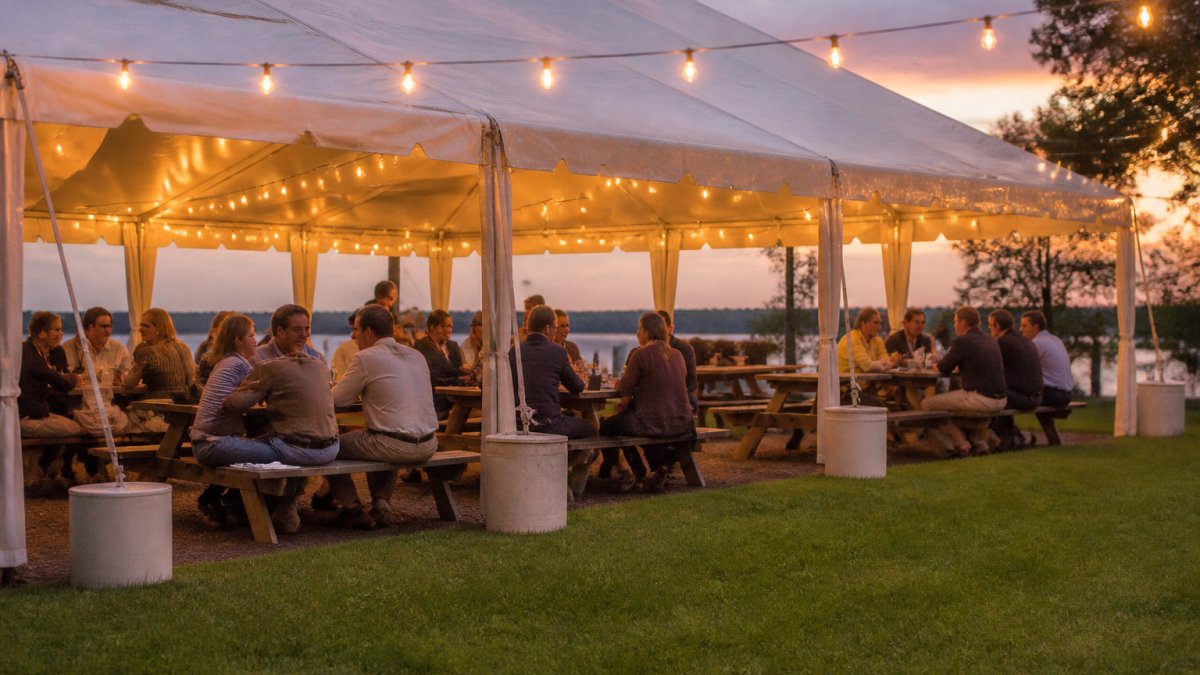
Seating should match the program. Long sessions need chairs with backs and armrests, while casual mixers work fine with picnic tables. Mix both if the day includes presentations and meals.
Lighting is where outdoor events often fall short. Pathways, food areas and any stage or speaking space need light before dusk.
Outdoor Event Tableware and Food Station Supplies
Tableware for a large group is mostly a planning and counting exercise. Streamlining the logistics of dining creates the necessary space to incorporate engaging group party games that keep the energy high throughout the afternoon.
For food stations, plan one station for every 40 to 50 guests to keep lines moving. Our guide on party supplies for large corporate events covers bulk tableware and branded decor in more detail, and our review of alternatives to standard party tableware compares disposable and reusable options if sustainability matters to your group.
Watch out: disposable plates and cups can blow away in wind, so weigh them down or use lidded containers at food stations for your outdoor corporate retreats.
Outdoor Team-Building Activities and the Gear They Need
Team-building activities determine the gear list. A scavenger hunt needs clipboards, pens and map printouts. A relay or field game needs cones, flags and timing equipment. A cooking or hands-on session needs tables, cutting boards and a cleanup plan.
Match the gear to the activity and to the physical demands. Some attendees will not want to run relays, so offer a low-intensity option alongside every active one.
Outdoor Event Weather Backup Plan: Supplies to Keep On Hand
Most guides stop at “bring ponchos.” A weather-ready plan is really four plans, rain, heat, wind, and cold, each with a supply kit and a decision trigger that tells you when to switch. Agree on those triggers with your venue and key organizers in advance so the call is not made in the moment.
Rain: the switch plan
Pack a tarp or pop-up canopy with sidewalls, ponchos or umbrellas for at least the full headcount, and dry-zone seating that can move under cover in minutes. Pre-mark an indoor fallback room and confirm its capacity in writing. A common pattern is to set the rain decision 24 to 48 hours out for a full program change, and a shorter 2-to-4-hour trigger for a passing cell.
Heat: the threshold plan
Heat is the most underestimated outdoor risk for a daytime retreat. Provide extra water and electrolyte packets, sunscreen, hats, and a shaded rest area, and schedule active blocks for morning or late afternoon. Many organizers use a heat index threshold, commonly around 90°F, to move or shorten strenuous activities and add mandatory water breaks. Have a cool-down zone with shade, seating, and cold water, and brief attendees on early signs of heat illness.
Wind: the anchoring plan
Wind takes down canopies and scatters disposable tableware. Use weighted bases and stakes rated for your surface, add sidewalls only when the canopy is properly anchored, and switch to lidded cups and weighted napkins at food stations. Set a wind trigger, many planners treat sustained gusts near 20 mph as the point to drop canopies and move to a sheltered area, and keep a wind-rated backup plan for any tented program.
Cold: the comfort plan
Evening programs and shoulder-season retreats need blankets or fleece layers, a hot beverage station, and lighting that does not depend on daylight. Pack hand warmers and a few spare layers for attendees who underdress, and move seated sessions toward the warmest part of the day.
The weather supply kit
- Rain: canopy with sidewalls, tarp, ponchos or umbrellas for the full headcount, lidded storage bins, absorbent mats
- Heat: extra water and electrolyte packets, sunscreen, hats, shade structures, cooling towels, a shaded rest zone
- Wind: weighted bases, stakes, lidded cups, weighted napkins, a plan to drop canopies
- Cold: blankets, spare layers, hand warmers, hot beverage service
- Communication: a weather alert app or radio, a printed emergency contact sheet, a charged power bank, and a designated weather caller who makes the final decision
Do not rely on a single forecast. Check the National Weather Service forecast and any local alerts the morning of the event, and name one person who owns the go/no-go call.
Packing for weather is far cheaper than rescheduling a booked day. Stage the weather kit in labeled bins so it can be deployed without a last-minute scramble, and return anything unused to inventory for the next retreat.
Booking Your Retreat Supplies With RI Party Store
RI Party Store carries party supplies, balloon décor and event rentals for groups across Rhode Island and Southeastern Massachusetts. Repeat or large corporate bookings can also get trade pricing on RI Party Store supplies through the Event Pro program.
Order early, confirm delivery windows in writing, and build your checklist around the categories above. Find reliable party supply delivery to your Massachusetts home if your group is ordering from a Massachusetts address.
Frequently Asked Questions
What supplies do you need for an outdoor corporate retreat?
Start with the number of attendees and the schedule, then list supplies by zone: check-in, meals, activities, and rest areas. Quantities depend on headcount and duration, so plan extra cups, napkins, and drinkware for a full-day event. Request a quote from RI Party Store.
How do you keep food and drinks safe at an outdoor retreat?
Keep cold food in coolers with ice packs and keep hot food hot in insulated carriers, and do not leave perishable items out for extended periods in warm weather. Use covered serving stations and separate trays for each item to limit contamination. Provide hand-sanitizing stations at food tables and label dietary options clearly. Plan for water and shade so attendees stay hydrated during activities.
What should you include in an outdoor event weather backup plan?
A weather backup plan should include a rain location with seating, tent weights and anchoring gear, extra tablecloths and covers for electronics and food, and a clear decision time for switching plans. Keep spare umbrellas, ponchos, and towels on hand, and confirm which rentals include weather protection. Communicate the backup plan to attendees before the event so they know where to go if conditions change.
What outdoor games work well for corporate team building?
Relay races, scavenger hunts, cornhole, and tug-of-war are common choices because they need little setup and work for mixed skill levels. Match the activity to group size and space, and include accessibility options so every attendee can take part. Supply needs are usually simple: bags, cones, rope, and clearly marked boundaries. Confirm equipment needs in advance so the activity setup does not slow the schedule.
