
Are Foam Parties Safe for Mixed Age Groups? 2026 Guide
Table of Contents
- Are Foam Parties Safe for Mixed Age Groups? The Short Answer
- How Foam Parties Work and What to Expect
- Foam Party Age Limit: What Works for Toddlers, Kids, Teens, and Adults
- Foam Party Safety Tips for Mixed-Age Events
- What to Wear to a Foam Party (and What to Avoid)
- Foam Party Duration: How Long Is Too Long?
- Sensitivities, Allergies, and Product Verification
- Weather, Setup, and Emergency Planning
- Frequently Asked Questions
Last Updated: October 12, 2026
Are Foam Parties Safe for Mixed Age Groups? The Short Answer
Yes, foam parties are safe for mixed age groups when the setup, supervision, and foam product are matched to the youngest and most sensitive guests. This guide from RI Party Store covers how to plan a foam party that works for toddlers, teens, and adults at the same event.
Foam parties use a machine that mixes foam solution with water and air to blow thick piles of bubbly foam into a play area, usually outdoors, where guests run, dance, and play.
A mixed-age group has mixed needs, a 4-year-old and a 14-year-old cannot follow the same rules. Below: age-specific guidance, safety tips, and a planning checklist.
Safety at a mixed-age foam party comes down to three things: a safe foam product, clear age-based rules, and enough adults watching the play area.
How Foam Parties Work and What to Expect
A foam machine pumps bubbly foam through a nozzle or cannon into a play area, often a lawn or padded surface, while guests walk, dance, and play.
Setup takes a short block before guests arrive. The machine needs water and power, and the play area should be flat and clear of sharp objects.
Here is what a typical event looks like:
- Machine setup and a test run before guests arrive
- Foam builds up over the first few minutes
- Guests play in the foam in short bursts
Foam does not last forever, so run the machine in cycles to keep the play area fresh.
Foam Party Age Limit: What Works for Toddlers, Kids, Teens, and Adults
There is no single foam party age limit. What changes by age is supervision, foam depth, type of play, and session length. The mistake most hosts make is writing one rule set for the whole crowd; a mixed-age event needs age-banded rules running at the same time in the same space.
A practical approach: three zones and two time blocks. Zone A is shallow and low-traffic for toddlers and preschoolers, Zone B is moderate-depth for school-age kids, and Zone C is deeper and higher-energy for teens and adults.
Toddlers and Preschoolers (Ages 2-5)
Toddlers need the closest supervision. Keep them in a shallow foam area separate from older kids, with an adult within arm’s reach at all times. Foam depth should stay below the knee so a small child can see their feet and recover from a stumble.
Use a gentle, tear-free foam solution, avoid deep piles that block a small child’s view or footing, and cap active play at 15 to 20 minutes per burst.
School-Age Kids (Ages 6-12)
Kids this age can play more freely but still need eyes on them. Set clear rules against running on wet surfaces and pushing, keep foam depth moderate (roughly mid-calf), and give this group its own entry and exit point so they do not cross the toddler zone.
This age band is most likely to invent rough games, so a simple rule set works better than a long list: no tackling, no throwing foam at faces, and no re-entering without a rinse. A 30-minute block with a water break fits most school-age groups.
Teens and Adults
Teens and adults can handle active foam play, but slippery surfaces still cause slips. Ban rough play, keep the foam area separate from younger kids, and brief everyone on the boundary line before the machine starts.
Adults often underestimate foam on hard surfaces, even a shallow layer over concrete or pavers is slicker than wet grass. If the only surface is hard, keep adult play to a walk-and-dance pace.
| Age Group | Foam Depth | Supervision Level | Session Length | Key Rule |
|---|---|---|---|---|
| Toddlers (2-5) | Below knee | Within arm’s reach | 15-20 min bursts | No running |
| Kids (6-12) | Mid-calf | Eyes on at all times | ~30 min with a break | No pushing or tackling |
| Teens/Adults | Mid-calf to knee | Periodic checks | 30-45 min | No rough play |
Running a Mixed-Age Event Without Splitting the Party
If you have one play area, use staggered time blocks instead of separate zones: announce a toddler block, clear the area, then open it to older kids, then teens and adults.
A quiet zone matters as much as the play zone. Set up a shaded area with towels, water, and seating where sensory-sensitive guests, kids needing a break, and watching adults can step out without leaving the event.
Age limits are less important than age-banded rules. Match foam depth, session length, and supervision to the youngest guest in the zone, and rotate older guests through separate time blocks.
Foam Party Safety Tips for Mixed-Age Events
The biggest mistake at a mixed-age foam party is treating every guest the same, one rule set does not work when a toddler and a teenager share a play area.
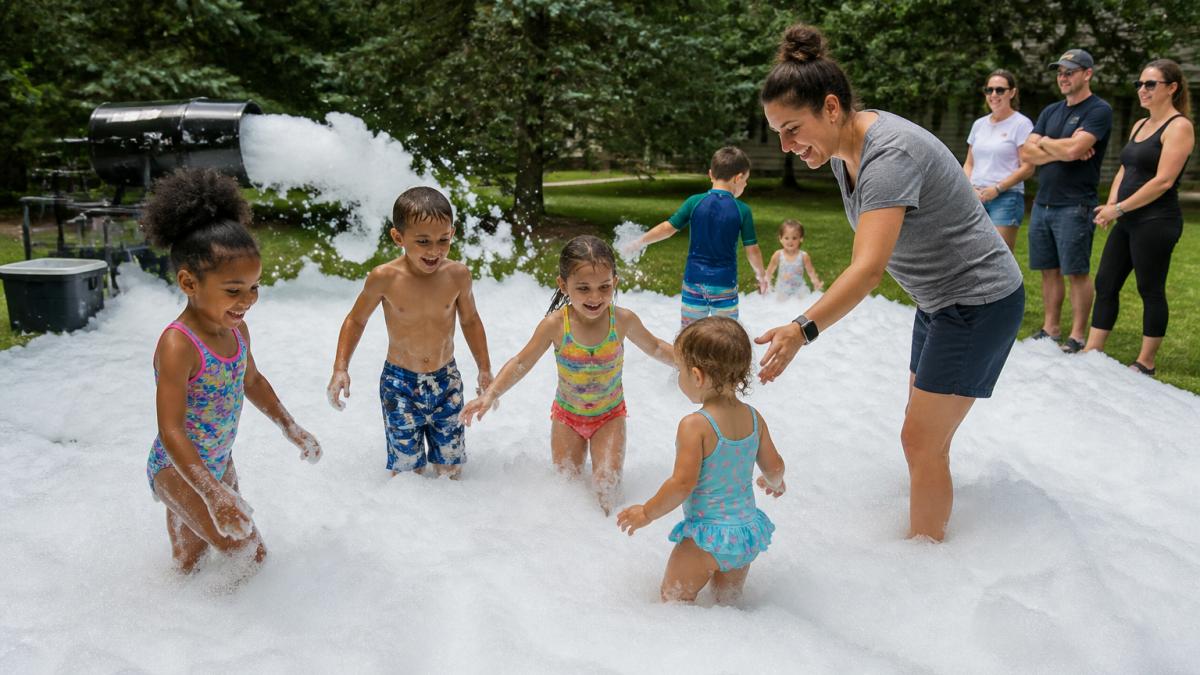
Maintaining a safe environment requires balancing active foam play with other engaging toys for mixed ages to ensure that children of all developmental stages remain occupied and supervised.
Split the play area by age when you can: younger kids in a shallow zone, older guests in a deeper one. This one change prevents most collisions and slips.
Supervision Ratios by Age Group
A common approach is one adult per few toddlers and a lighter ratio for older kids. The principle is simple: the younger the guest, the closer the watch.
- Toddlers: one adult per small group, within arm’s reach
- School-age kids: one adult watching a larger group
- Teens and adults: periodic checks, with a rule against rough play
Slip, Fall, and Water Hazards
Slippery surfaces cause most foam party injuries. Foam plus water equals a slick floor. Set these rules before guests arrive:
- No running in or near the foam
- No bare feet on wet grass or pavement
- No re-entering the foam after leaving the play area without a wipe-down
The most common foam party injury is a slip on a wet surface, not a reaction to the foam. Keep walkways dry and set a no-running rule from the start.
What to Wear to a Foam Party (and What to Avoid)
What to wear to a foam party matters more than most hosts expect. The right clothing keeps guests comfortable and cuts down on slips.
Wear:
- Swimsuits or quick-dry clothing
- Water shoes or secure sandals with grip
- Goggles for guests with sensitive eyes
Avoid:
- Flip-flops that slip off in wet foam
- Heavy cotton clothing that soaks up water
- Loose jewelry or items that can fall off
Have towels and a dry change of clothes ready, plus a dry zone near the play area so guests can step out without tracking water everywhere.
Foam Party Duration: How Long Is Too Long?
Foam party duration should stay short, especially for younger guests, 30 to 60 minutes of active play, broken into shorter bursts for toddlers.
Longer is not better: kids tire out, get cold when wet, and lose focus. Running the machine in cycles keeps foam fresh and gives guests breaks.
Watch for signs that a guest has had enough:
- Shivering or cold skin
- Rubbing eyes or complaining of irritation
- Sitting out or losing interest
When you see these signs, pull the guest out, dry them off, and let them rest.
Sensitivities, Allergies, and Product Verification
Sensitive skin, allergies, and respiratory sensitivities are top concerns for parents. The fix is not a broad claim that foam is “safe” or “non-toxic”, it is verifying the specific product, dilution, and equipment cleaning before the event.
What to Ask a Foam Party Provider
A provider who knows their product answers these without hesitation. If they cannot, treat it as a red flag.
- What foam solution do you use, and what is the brand or product name?
- What is the dilution ratio, and is it mixed on site or pre-mixed?
- Do you have a safety data sheet (SDS) for the concentrate?
A safety data sheet (SDS) is the standard document manufacturers provide under the OSHA Hazard Communication Standard, listing hazards, first-aid measures, and handling guidance. Ask to see the SDS for the concentrate, not a marketing page, the concentrate is what matters for sensitivity questions, and the dilution ratio tells you how much.
Respiratory, Eye, and Skin Sensitivities
Guests with asthma, seasonal allergies, eczema, or contact lenses need a plan before entering the foam.
- Asthma and respiratory conditions: Fine aerosolized foam and any fragrance in the solution can trigger symptoms. Guests with asthma should stay at the edge of the play area, keep a rescue inhaler within reach, and avoid standing directly in the machine’s output path.
- Contact lenses: Foam and water can trap irritants against the eye. Guests who wear contacts should switch to glasses or use tight-fitting swim goggles for the event.
- Eczema and active flare-ups: Broken or inflamed skin is more vulnerable to irritation. Skip the foam entirely for guests with open cuts or active skin flare-ups, and patch-test the foam on a small area of skin first for guests with known sensitivities.
Product Labels and What They Actually Mean
Labels like “non-toxic,” “hypoallergenic,” and “biodegradable” are useful signals but not guarantees. “Hypoallergenic” means less likely to cause a reaction, not impossible; “biodegradable” describes environmental breakdown, not skin behavior. Read the ingredient list for fragrances, dyes, and preservatives, the most common triggers for sensitive guests.
For guests with known sensitivities:
- Patch-test the foam on a small area of skin first
- Keep a rinse station with fresh water nearby
- Have guests with asthma or eye conditions stay at the edge of the play area
Ask to see the foam solution’s safety data sheet before you book, and ask what the dilution ratio is. A provider who can hand both over without hesitation is one who knows their product.
If a guest develops hives, swelling, wheezing, or trouble breathing after foam contact, treat it as a medical emergency. Call 911 and follow dispatcher instructions.
Weather, Setup, and Emergency Planning
Weather and setup decide how safe a foam party really is. Heat, wind, and cold all change the plan.
On hot days, watch for overheating and offer water breaks.
Setup tips for a safer event:
- Choose a flat, grassy area away from pavement and sharp objects
- Keep the machine on a stable surface with cords out of walkways
- Set up a dry zone for towels and shoes
Emergency planning is the step most hosts skip.
At RI Party Store, we help families across Rhode Island and Southeastern Massachusetts plan foam parties with clean equipment and clear setup guidance.
Frequently Asked Questions
Are foam parties safe for toddlers and young children?
Toddlers can join a foam party with extra precautions. Keep foam shallow, around ankle depth, and stay within arm’s reach at all times. Use a minimum 1:1 adult-to-toddler ratio. Check that the foam solution is labeled non-toxic, hypoallergenic, and tear-free. Skip the foam machine’s high-output setting for this age group, and have a towel and fresh clothes ready for when they exit. Most toddlers last 10-15 minutes before getting cold or overwhelmed.
What age is appropriate for a foam party?
There is no universal foam party age limit, but most rental companies and event planners suggest age 2 and up with direct adult supervision. Children under 2 should stay out of the foam area. Kids ages 3-5 do best in shallow foam with a nearby adult. Ages 6 and up can handle deeper foam and longer sessions. Teens and adults can enjoy full-output foam parties with standard safety measures in place.
Can toddlers and older kids play in foam together?
Yes, but stagger the sessions. Run a 15-minute toddler round in shallow foam first, then let older kids play in deeper foam after toddlers have exited and been dried off. This prevents bigger kids from accidentally knocking over smaller ones on a slippery surface. If you want everyone in at once, set clear age-appropriate rules: no running, no pushing, and keep toddlers in a designated shallow zone.
How do you supervise a foam party with mixed ages?
Assign one adult per two toddlers, one adult per four school-age kids, and one adult per eight teens or adults. Position supervisors around the perimeter, not inside the foam. Give each supervisor a specific zone and a whistle or signal. Brief them on the emergency exit path and where towels and water are kept. A head count every 15 minutes keeps track of who is where, especially when foam obscures visibility.
How long should a foam party last for children?
For toddlers, 10-15 minutes per session with a break is plenty. Kids ages 6-12 can handle 20-30 minute sessions before needing a water and rest break. Total foam party duration for a children’s event usually runs 45-60 minutes, including setup and wind-down. Teens and adults can go longer, but plan breaks every 30 minutes. Watch for shivering, red eyes, or crankiness, which signal it is time to stop.
A mixed-age foam party takes more planning than a single-age one, but the payoff is an event everyone can enjoy together. The key is matching foam, rules, and supervision to your youngest and most sensitive guests. RI Party Store offers foam party rentals with clean equipment, professional setup, and friendly guidance for your event. Get started with RI Party Store and plan a foam party that works for every age in the crowd.