
7 Steps to Choose the Right Foam Machine for Your Event
Last Updated: October 29, 2026
Quick Summary
To choose the right foam machine, match its output to the number of people in the foam at once and the size of your foam zone, then confirm the site’s power, water, and drainage before you commit. Size the machine using play area, foam depth, and session length rather than total headcount.
- Measure your foam zone in square feet and plan 6-12 inches of depth for kids.
- Refresh the foam pad every 10-15 minutes during active play because foam collapses as it sits.
- Plan a dedicated circuit for the machine and add up the amps of everything on it.
- Use the shortest 12-gauge or 14-gauge outdoor-rated cord and a GFCI-protected outlet.
- Renting fits most hosts, while buying makes sense if you host often or run events as a business.
Table of Contents
- Start With Your Event Type and Space
- Match Foam Machine Output and Coverage to Your Crowd
- Pick the Right Foam Machine for a Kids Party
- Check Power, Water, and Site Requirements Before You Commit
- Foam Machine Safety Rules Every Host Should Know
- Buy or Book a Foam Machine Rental?
- Confirm Foam Solution Compatibility and Cleanup Plan
- Book Your Foam Machine With a Local Team
- Frequently Asked Questions
Start With Your Event Type and Space
Knowing how to choose the right foam machine starts with one question: where will the foam actually land? A machine that turns a backyard into a hit can flood a driveway or disappear into an open field.
A foam machine is a device that mixes foam solution with air and water to produce a steady stream of bubbles for parties and events. Output, power needs, and cleanup all depend on the model you pick.
Start by writing down three things:
- The event type (birthday, graduation, wedding, community event)
- The surface under the foam (grass, pavement, artificial turf)
- The rough footprint you can dedicate to foam play
Indoor, Backyard, or Open Field
Each setting changes what machine you need. Indoor use is rare because foam makes floors slick and hard to control. Most hosts choose outdoor setups.
Backyards suit small to mid-size machines. Open fields and large venues need higher output and more water access. For a deeper playbook on backyard setups, our guide on how to organize a backyard foam party walks through the full plan.
Match Foam Machine Output and Coverage to Your Crowd
Output capacity is the number that decides whether a machine fits your crowd, and it is the number most buyers misread. Foam machines are rated by production volume, typically gallons per minute (GPM) of foam solution pushed through the nozzle, sometimes listed as liters per minute or as cubic feet per minute of finished foam. Those are not the same measurement, so convert before you compare: 1 gallon per minute is about 3.8 liters per minute, and finished-foam volume depends on the machine’s air-to-solution ratio, which most manufacturers publish as a fixed ratio (commonly in the 10:1 to 30:1 range).
Do the Math Before You Buy
Use three inputs to size a machine instead of guessing from headcount:
- Play area. Measure the foam zone in square feet. A typical backyard foam pad is 20 ft × 30 ft (600 sq ft); a school field session might be 50 ft × 80 ft (4,000 sq ft).
- Foam depth. Shallow foam for kids runs about 6-12 inches deep; deep foam for a “foam pit” feel runs 18-24 inches. Depth drives volume far more than area does.
- Session length and refresh rate. Foam collapses as it sits, so plan to refresh the pad every 10-15 minutes during active play.
A rough volume estimate: area (sq ft) × depth (ft) = cubic feet of foam needed for one fill. A 600 sq ft pad at 1 ft deep is 600 cubic feet. At a nominal 20:1 ratio, that is about 30 cubic feet of solution, roughly 225 gallons, to fill once. If the machine produces 1 GPM of solution, one fill takes about 3.75 hours of runtime, which is why most hosts run timed sessions and refresh rather than trying to fill a deep pit in one pass.
Sizing Table With Output Ranges
| Crowd in Foam at Once | Foam Area (typical) | Solution Output Class | Session Pattern | Typical Use |
|---|---|---|---|---|
| Up to 15 kids | 300-600 sq ft, 6-12 in deep | Small-scale, under ~0.5 GPM | 10-15 min sessions, 2-3 refreshes | Backyard birthday |
| 15-50 guests | 600-1,500 sq ft, 6-12 in deep | Mid-size, ~0.5-1.5 GPM | 15 min sessions, staggered groups | Family events, school parties |
| 50-150 guests | 1,500-4,000 sq ft, 12-18 in deep | Commercial, ~1.5-3 GPM | Continuous with a dedicated refill operator | Festivals, community events |
| 150+ guests | Multiple zones or 4,000+ sq ft | High-output commercial, 3+ GPM | Timed waves with a second machine or zone | Large venues |
Two rules keep output honest. First, match production volume to how many people will be in the foam at once, not total headcount, a 100-guest party with 20 kids in the foam at a time needs the 20-person row, not the 100-person row. Second, plan foam in timed sessions so the machine keeps up and the pad stays deep enough to be fun.
Ask the supplier for the machine’s rated GPM and its air-to-solution ratio, then confirm the nozzle size and required water pressure. A machine rated at high output on a low-pressure spigot will underperform its spec sheet, and that gap is the most common reason a rental “feels weak” on arrival.
A common mistake is buying for the biggest crowd you might host. Many backyard hosts find that staggered sessions work better than an oversized unit they cannot power or refill.
Pick the Right Foam Machine for a Kids Party
For a kids party, prioritize safety, easy setup, and gentle output over raw power.
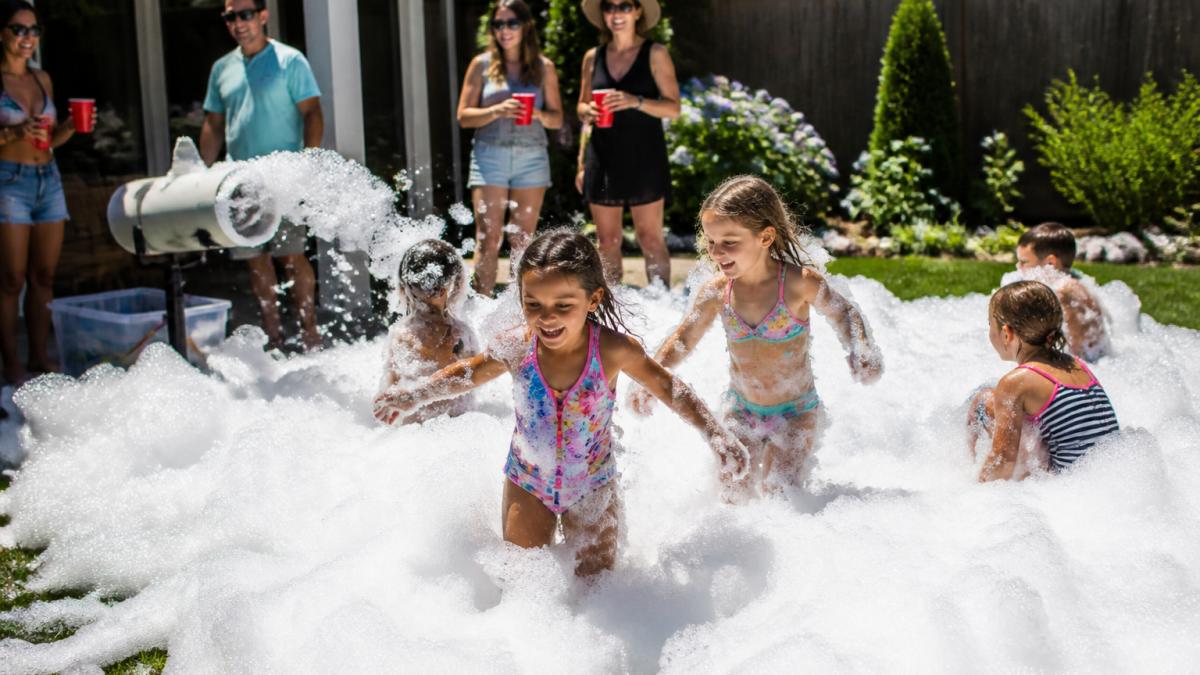
Children slip easily on wet grass and pavement. Shallow foam over a soft lawn works better than deep foam on concrete.
Pair the foam with other entertainment to keep the party moving. Our list of unique children’s party entertainment ideas shows options that work alongside a foam session.
For kids, check these features before you commit:
- Adjustable output so you can dial foam up or down
- A nozzle height that sprays away from faces
- Simple on/off controls a parent can manage
Check Power, Water, and Site Requirements Before You Commit
Most foam machine problems trace back to power and water, not the machine itself. Confirm both before you book or buy, and confirm them against the actual site, not the site you wish you had.
Electrical Voltage, Amperage, and Cord Reach
Foam machines run on electric motors, and the spec sheet tells you what the circuit must supply. Check three numbers before you commit:
- Voltage. Most consumer and light-commercial foam machines are 120V units that plug into a standard household outlet; larger commercial units may be 240V and need a dedicated circuit. Match the machine to the outlet you actually have.
- Amperage draw. A 120V machine drawing 12 amps uses most of a standard 15-amp household circuit. If anything else shares that circuit, lights, a DJ, a bounce house blower, you will trip the breaker mid-party. Plan a dedicated circuit for the foam machine and add up the amps of everything on it.
- Cord length and gauge. The machine’s cord is short by design. Extension cords add resistance and voltage drop, which strains the motor. Use the shortest 12-gauge or 14-gauge outdoor-rated cord that reaches, keep the connection out of wet zones, and use a GFCI-protected outlet or an inline GFCI adapter. Never run a cord through standing water or across a walkway where guests will trip.
A tripped breaker is the most common mid-event failure. Before the event, test the circuit with the machine running and every other load you plan to use switched on. If it trips, move a load, do not swap in a bigger breaker.
Water Supply, Pressure, and Hose Reach
Foam needs a steady water supply at adequate pressure. Check how far your hose reaches, whether the machine connects to a standard garden spigot or needs a different fitting, and whether the unit has its own tank or requires a constant feed. Tank-fed units are more flexible on site but need refilling; constant-feed units need a spigot within hose distance and stable pressure.
Site Suitability and Drainage
Site suitability is where rentals and purchases diverge most. Walk the site and check:
- Surface. Grass drains and cushions falls; pavement and artificial turf get slick fast and need active rinsing. Avoid slopes where foam and runoff pool at the bottom.
- Drainage. Know where the runoff goes. Foam solution and water should not drain toward a pool, storm drain, basement, or neighbor’s property. A slight grade away from structures is ideal.
- Clearances. Keep the play zone away from pools, steps, electrical panels, and traffic. Leave a dry staging area for the machine and cords.
Total Cost of Ownership, Not Just Purchase Price
Purchase price is only the first line item. Compare machines on total cost of ownership: solution or powder per session, water and power use, replacement nozzles and pumps, routine cleaning time, and transport if the machine moves between sites.
If you’re renting, our foam machine rental setup guide covers power, water, and site needs in full before the truck arrives.
Foam Machine Safety Rules Every Host Should Know
Foam machine safety comes down to supervision, surfaces, and solution handling. Set rules before the first spray and post them where guests can see them.
- Always have an adult watching the foam zone
- Keep the play area away from pools, stairs, and traffic
- Use a slip-resistant surface or soft grass
Solution safety matters too. Use only foam solution and powder made for machines, and follow the label ratios.
For broader rental safety habits, our bounce house rental safety tips reinforce practices that apply to foam equipment as well.
Buy or Book a Foam Machine Rental?
Renting fits most hosts; buying fits repeat organizers. Logistical considerations remain consistent regardless of the specific items involved, so establishing a reliable process for renting party equipment ensures that every inflatable or foam installation proceeds without a hitch.
Ask yourself:
- How many times a year will I use it?
- Do I have storage space and a power source?
- Do I want to handle cleaning and solution mixing?
For most families planning one or two parties, renting wins on cost and effort. If you’re comparing options for a kids event, our foam party rental packages for kids lay out what’s available.
Confirm Foam Solution Compatibility and Cleanup Plan
Foam solution compatibility affects both performance and cleanup. Every machine works best with the solution and foam powder type it was built for. Check the manufacturer’s guidance before you buy chemicals.
Biodegradable options are common and easier on lawns. Still, plan to rinse the play area and let it dry.
Cleanup checklist:
- Turn off water and power before disassembly
- Flush the machine per the manual
- Rinse the play area and any slick pavement
Watch out: skipping the flush leaves residue that clogs nozzles and shortens the machine’s life.
Book Your Foam Machine With a Local Team
Choosing the right equipment is half the job. The other half is a team that shows up, sets up, and handles the details so you can enjoy the party.
We keep party supplies and rentals under one roof, so you can plan foam, décor, and entertainment in one stop.
Get started with RI Party Store and book a foam machine that fits your space, your crowd, and your budget.
Frequently Asked Questions
What size foam machine do I need for a kids’ party?
For a backyard party with 15 to 30 children, a smaller machine that puts out a steady stream over a 20 to 30 foot area is usually enough. Larger machines cover more ground faster, which matters once you pass roughly 50 guests or want a foam zone big enough for kids to run through. Measure your yard or venue first, then compare machine coverage to that footprint. A machine that is too small leaves kids standing around waiting for foam.
Is it better to buy a foam machine or rent one?
Renting makes sense for one or two events a year. Renting means you are not storing equipment or learning maintenance. Buying only pays off if you host regularly or run events as a business, since you take on storage, cleaning, solution costs, and repairs. For most family parties, foam machine rental is the lower-risk choice.
How much space do you need for a foam machine?
Plan for a flat, drained area at least 20 by 20 feet for a small setup, and more for larger machines. Keep the foam zone away from electrical outlets, pools without fencing, and hard surfaces like driveways that get slick. Grass is the safest surface because it drains and cushions falls. Leave a clear path for kids to exit the foam so they are not bumping into each other.
Are foam machines safe for children’s parties?
Foam machines are safe when the setup is right. Keep cords and the motor out of the wet zone, and have an adult supervise at all times. Rinse kids off afterward, especially if they have sensitive skin. Ask the provider what solution they use before you book.
