
How to Organize Outdoor Birthday Party Games for 8 Year Olds
Table of Contents
- Why 8-Year-Olds Need Games With Clear Rules and Fast Pivots
- Pick Birthday Party Games for 8 Year Olds That Match Their Energy
- Outdoor Birthday Party Games With No Equipment (Or Almost None)
- Build a Birthday Party Game Schedule for Kids That Actually Flows
- Plan for Group Size, Space, and Setup Before the Day Of
- Safety, Allergies, and Accessibility for Every Guest
- Rainy Day Backup Activities for a Kids Party
- Conclusion
- Frequently Asked Questions
Last Updated: October 21, 2026
Why 8-Year-Olds Need Games With Clear Rules and Fast Pivots
Eight-year-olds want to win, want to move, and lose interest in ninety seconds if the rules take too long.
This guide shows how to organize outdoor birthday party games for 8 year olds so the day runs itself, picking games, scheduling them, planning for space, and handling surprises.
Most guides hand you a list of ideas and stop there. A list isn’t a plan.
The best game for this age group is the one with a rule you can explain in one sentence and a turn that lasts under three minutes. Everything else is decoration.
Pick Birthday Party Games for 8 Year Olds That Match Their Energy
The right birthday party games for 8 year olds fall into three buckets: active, team, and target games. Rotate through all three to cover every energy level in the group.
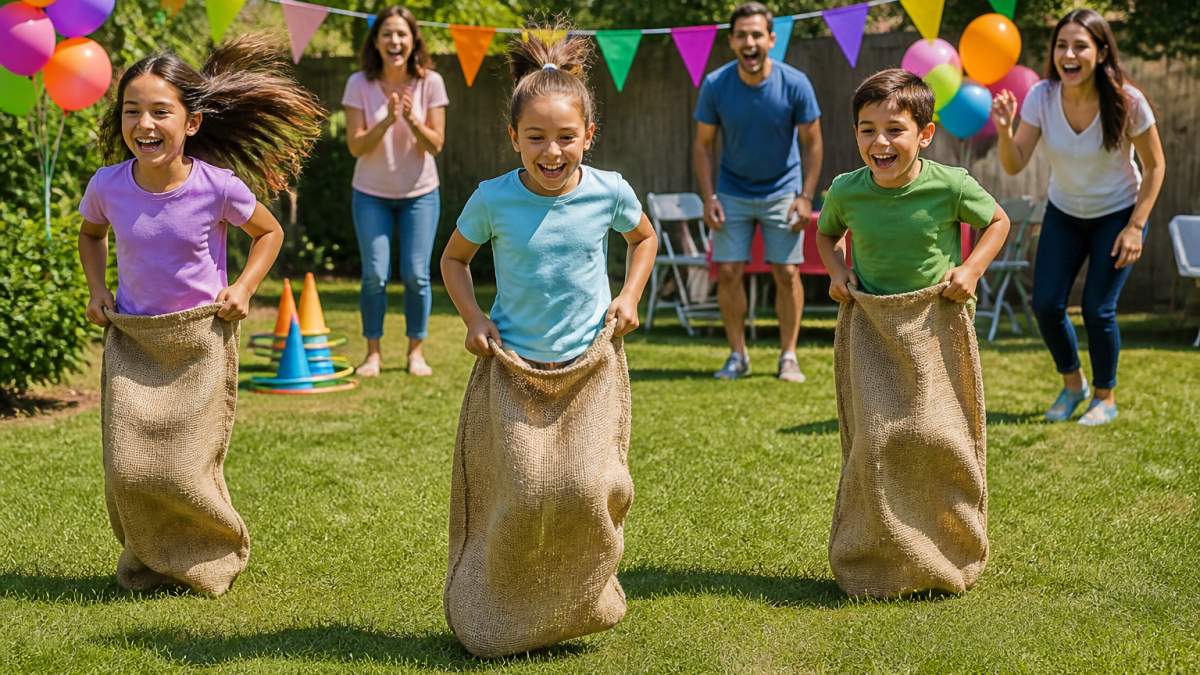
Active Games: Races, Relays, and Running
Running games burn the most energy and need the least setup. A sack race, three-legged race, and simple relay cover twenty minutes with a few sacks and a start line.
Keep heats short. Four kids per heat, then rotate. Kids this age hate waiting more than they hate losing.
Team Games: Kickball, Capture the Flag, and Relay Races
Team games need balanced sides. Split teams by counting off rather than letting kids pick, which avoids hurt feelings and lopsided games.
Kickball works best with a soft ball and a clear first base. Capture the Flag needs a defined boundary and one adult per side watching the jail area.
Target Games: Ring Toss, Water Balloon Toss, and Human Piñata
Target games give less athletic kids a real shot at winning. Ring toss over plastic bottles, a partner water balloon toss, and a human piñata all work well.
The human piñata is the sleeper hit. One child wears a decorated box or holds a basket, others toss soft foam items, and everyone gets a turn.
Outdoor Birthday Party Games With No Equipment (Or Almost None)
You can run a full hour of outdoor birthday party games with no equipment at all, the backup plan when supplies run short or the group needs a reset.
Here’s what works with nothing but kids and a yard:
- Freeze tag with a designated “unfreezer”
- Red light, green light with a caller at the far end
- Simon says with silly physical commands
Fort building deserves its own slot. Give teams ten minutes and a pile of boxes, blankets, and rope, twenty minutes of building for two minutes of judging is a great ratio.
Print two copies of your scavenger hunt list and laminate them. Kids this age will argue about who found what, and a laminated list with a dry-erase marker settles it fast.
Build a Birthday Party Game Schedule for Kids That Actually Flows
A birthday party game schedule for kids should alternate high-energy and low-energy games so nobody burns out in the first twenty minutes, the biggest mistake we see hosts make. But the schedule is only half the job; the other half is the transitions, where most parties stall.
Eight-year-olds don’t transition well from a dead stop. They need a signal, a destination, and a reason to move, build those into every changeover.
The Pacing Rule for Eight-Year-Olds
Plan blocks of 12 to 15 minutes per game, with a hard stop at 15. Attention holds roughly that long on a structured activity; past 15 minutes kids drift to the sidelines. If a game is a hit, run a second round, but treat that as a bonus, not the plan.
Alternate the energy curve like this:
- High-energy opener (running or racing) while the group is fresh and arriving
- Low-energy reset (target or craft game) to bring the heart rate down
- High-energy team game before food, when hunger hasn’t fully set in
Transition Mechanics That Actually Work
A transition is not ‘okay, everyone to the next game.’ That produces chaos. Use these instead:
- A whistle or call-and-response signal. Pick one sound, a whistle, a bell, a shouted ‘party freeze!’, and use it only for transitions. Kids learn it after two rounds.
- A gathering spot. Mark a cone or a chalk circle as the ‘meeting spot.’ Every transition ends there, not at the next game. It gives kids a destination and gives you a headcount.
- A 30-second countdown. Announce the last 30 seconds of every game. Kids this age handle endings better when they see them coming.
A Sample 90-Minute Game Timeline
| Time | Game | Type | Setup Needed |
|---|---|---|---|
| 0-10 min | Freeze tag | Active | None |
| 10-25 min | Sack race heats | Active | Sacks, start line |
| 25-40 min | Ring toss | Target | Plastic bottles, rope rings |
| 40-55 min | Kickball | Team | Soft ball, bases |
| 55-70 min | Water balloon toss | Target | Filled balloons, towels |
| 70-90 min | Scavenger hunt | Low energy | Printed lists |
Build in five minutes of buffer between each block. Transitions always take longer than you think.
How to Shrink or Stretch the Schedule
Not every party runs 90 minutes of games. Adjust the block count, not the block length:
- 60-minute game window: cut to four blocks, one active opener, one target game, one team game, one low-energy closer. Skip the second active block.
- 2-hour game window: add a second team game and a free-play block. Free play is not filler; it’s where kids self-organize and hosts catch their breath.
- Mixed ages (5-10): keep the same sequence but shorten active blocks to 10 minutes and add a seated target game as the reset. Younger kids tap out of running games faster; older kids need the team game to stay engaged.
Write the schedule on a small whiteboard or index card and keep it in your pocket. Announcing ‘next up is ring toss’ from memory is how hosts lose track of time and end up running games into the cake cutting.
The most common schedule failure is stacking two high-energy games back to back because the first one went well. Resist it. The second game always underperforms, and you’ll spend the rest of the party managing overstimulated kids instead of running games.
Plan for Group Size, Space, and Setup Before the Day Of
Group size and space decide which games you can actually run, a game that works with eight kids falls apart with twenty. Match each game to three numbers before the day: guest count, square footage, and adults who can actively supervise.
Match Games to Guest Count
Use this as your guide:
- Under 8 kids: every game on the list works, including team games with small sides. You can run one station at a time and give every kid a turn in each round.
- 8-15 kids: run two stations at once and split the group. Pair a high-energy station with a low-energy one so the groups rotate through different energy levels.
- 15+ kids: stick to active games with short heats and one team game max. Above 15, waiting becomes the dominant experience unless you run parallel heats.
Match Games to Space
Measure your yard or park spot before the day. These are working minimums, not ideal dimensions:
- Kickball: a clear run of about 15 meters (roughly 50 feet) from home to first base, plus a foul line. A soft ball and a marked first base are enough; you don’t need a full diamond.
- Capture the Flag: a boundary you can mark with stakes and rope, ideally at least 20 by 30 meters (about 65 by 100 feet) so the jail area and both flags have room. Smaller spaces turn the game into a scrum.
- Sack race and relay races: a straight run of 10 to 15 meters. Grass is better than pavement; sacks on concrete are a slip hazard.
Supervision Ratios
A common pattern among hosts is one active adult per 6 to 8 kids for running games, and one per 10 for seated or target games, enough to catch a stray kickball or boundary dispute.
Assign roles before the party:
- One game leader who runs the rules and the whistle
- One roaming helper who isn’t tied to a station and can handle spills, bathroom runs, and lost shoes
- One boundary watcher for any game with a street, pool, or parking lot nearby
Setup Time Per Game
Budget setup time honestly. These are realistic windows for one adult:
- Freeze tag, red light green light, Simon says: under 2 minutes
- Sack race, three-legged race, relay: 5 minutes to mark the start line and lay out sacks
- Ring toss: 5 to 10 minutes to set bottles and mark the throwing line
Don’t place target games near a driveway, pool, or street edge. A water balloon toss on pavement turns into a slip hazard within seconds, and a stray kickball rolls faster than you can chase it.
Set up the first two games before guests arrive and stage the rest in labeled bins. A bin per game, sacks in one, bottles and rings in another, turns a 10-minute setup into a 2-minute swap between blocks.
Safety, Allergies, and Accessibility for Every Guest
Safety planning starts with a simple guest check before the party. Ask parents about allergies, mobility needs, and anything that limits physical activity. That one question prevents most problems.
The practical checklist:
- Confirm allergies on the invitation RSVP
- Keep water balloons away from kids with latex sensitivity
- Offer a seated version of every game, like a ring toss from a chair
Accessibility matters more than most hosts expect. A kid with a cast or sprained ankle should still get a turn, seated ring toss, a scavenger hunt from a wagon, and a “team captain” role all keep everyone included.
Rainy Day Backup Activities for a Kids Party
Rainy day backup activities for a kids party should be decided before the day, not during it. Have a plan you can switch to in five minutes.
Indoor alternatives that work for this age:
- Movie night setup with a starry night theme and floor cushions
- Indoor fort building with blankets and furniture
- Balloon games like keep-it-up and balloon relay
Extreme heat deserves the same treatment. Move games to early morning or late afternoon, add shade, and swap running games for water games.
That’s where a one-stop shop saves the day. RI Party Store stocks party supplies, balloon décor, and rentals under one roof, so a last-minute pivot doesn’t mean three stops.
Hosts who want the games, décor, and rentals sorted in one trip instead of juggling three stores.
Conclusion
The real challenge with outdoor birthday party games for 8 year olds isn’t finding ideas.
RI Party Store can help with that. We carry party supplies and balloon décor, rent bounce houses and foam parties, and offer in-store pickup, delivery, and professional setup for event rentals.
Get started with RI Party Store and turn the game plan into the easy part of the party. Shop Now.
Frequently Asked Questions
How many games should you plan for an 8-year-old’s birthday party?
Plan five to seven games for a two-hour party, with each game running 10 to 15 minutes. Eight-year-olds switch focus quickly, so having a couple of extra options ready helps if one game ends early. Mix active games like relay races with calmer ones like ring toss to keep energy balanced. Build in a snack break and cake time so the schedule does not feel rushed. If you are hosting outdoor birthday party games for a larger group, add one team game to keep everyone involved at once.
What outdoor birthday party games with no equipment work for a group of 8-year-olds?
Several outdoor birthday party games with no equipment work well: freeze tag, red light green light, Simon says, shadow tag, and a nature scavenger hunt using items already in the yard. These need nothing more than open space and clear rules. They are ideal for park parties where you cannot carry supplies. Print or write simple instructions on index cards so a helper can run each game without confusion.
What can you do if it rains during an outdoor birthday party?
Have rainy day backup activities for a kids party ready before the event: fort building with blankets and boxes, indoor scavenger hunts, charades, a movie night setup, or a craft station. Keep a bin packed with card games, balloons, and printable puzzles. If you rented a bounce house or foam party, ask the rental company about their weather policy and rescheduling options ahead of time so you are not scrambling the morning of the party.
How do you keep outdoor birthday party games safe for 8-year-olds?
Clear the play area of sharp objects, rocks, and tripping hazards before guests arrive. Set boundaries with cones or rope so kids do not wander into streets or driveways. Assign one adult to watch each active game, especially running and ball games. Check for allergies before any food-based game, and skip water games if the temperature is cool. Keep a first aid kit and water station nearby, and schedule rest breaks during hot weather.