
Sourcing Wholesale Event Decorations: A Business Guide
Last Updated: November 4, 2026
Quick Summary
Sourcing wholesale event decorations means buying balloons, tableware, linens and centerpieces in bulk from verified suppliers at lower unit costs. Start by getting a resale certificate, vet suppliers against a written scorecard, and time orders to your peak event calendar.
- Wholesale accounts usually require an EIN and a state sales tax or resale certificate.
- Vet suppliers on legitimacy, MOQ and price breaks, lead times, returns and references.
- Ask for lead times covering your three busiest months, not just the current month.
- Inspect production samples against written criteria before committing to a large order.
- Build a landed-cost worksheet that includes freight, duties, customs and handling fees.
Table of Contents
- Why Event Businesses Source Decorations Wholesale
- Step 1: Get Your Wholesale License for Event Planning
- Step 2: Identify Reliable Wholesale Event Decor Suppliers
- Step 3: Plan Bulk Sourcing Around Your Event Calendar
- Step 4: Check Quality, Ethics and Import Documentation
- Step 5: Manage Your Event Decor Inventory
- Avoiding Common Sourcing Pitfalls
- Start Sourcing Your Next Order at RI Party Store
- Frequently Asked Questions
Why Event Businesses Source Decorations Wholesale
Sourcing wholesale event decorations for businesses can cut costs and give your event company more control over what it sells and rents.
Party supply retail is growing. The U.S. party supplies market is expected to reach $12.7 billion by 2026, with a compound annual growth rate of 8.8% from 2021 to 2026 (ASD Market Week party supplies sourcing overview).
Decorations are also one of the faster-moving parts of the category. One market analysis points to decorations as one of the fastest-growing segments of the party supplies sector in 2026, with a compound annual growth rate of 10.16% (Party Sparkz analysis of fast-growing party supply segments).
Here is what wholesale sourcing usually offers:
- Lower unit costs on balloons, tableware, linens and centerpieces
- Consistent stock for peak seasons like graduations, weddings and holidays
- Better margins when you rent or resell decor to clients
- Control over quality, since you pick the suppliers
We know how much planning goes into a single event. This guide walks you through sourcing wholesale event decorations step by step, from licensing to inventory.
Step 1: Get Your Wholesale License for Event Planning
Before you buy at wholesale prices, you usually need a reseller or wholesale account. Most suppliers want proof that you run a real business.
A wholesale license is typically tied to a business tax registration. In the United States, that often means an Employer Identification Number (EIN) from the IRS and a state sales tax permit.
Here is what to prepare:
- Business name and registration documents
- EIN from the IRS
- State sales tax or resale certificate
- Business address and contact details
- Proof of your event business, such as a website or past client work
Suppliers use your resale certificate to confirm you buy for resale or rental. Keep copies on hand, because many wholesalers ask for them at account setup.
Step 2: Identify Reliable Wholesale Event Decor Suppliers
Finding a dependable source is the most important part of wholesale sourcing.
Start with three channels and work them in order:
- Trade shows and buying markets. These are the fastest way to see samples in person and meet sales reps who can quote volume pricing. Bring your resale certificate and a list of your top 20 SKUs.
- Industry directories and manufacturer websites. Manufacturer sites usually list authorized distributors, which matters if you need warranty support or consistent dye lots.
- Referrals from other event businesses. A supplier who already serves rental companies understands reuse, cleaning and replacement cycles.
Then qualify each candidate against a written scorecard. Some event businesses score suppliers on several dimensions before placing a first order:
- Business legitimacy. Ask for the legal entity name, years in business, and a physical address. Cross-check the entity against your state’s business registry and confirm the sales tax permit is active. A supplier who will not share an EIN or business license is a pass.
- Minimum order quantity (MOQ) and price breaks. Request the full price list with quantity tiers, not just the entry price. Ask whether MOQs are per SKU, per case, or per invoice, because a low headline MOQ can hide a high per-line minimum.
- Lead times and fill rate. Ask for quoted lead times for your three busiest months, not the current month. Ask what percentage of orders ship complete on the first attempt.
- Damage and return policy. Get the policy in writing. Confirm who pays return freight, whether damaged goods are replaced or credited, and how claims are filed. Photograph every pallet before you sign the delivery receipt.
- References. Ask for two references from businesses similar in size to yours. Call them and ask specifically about late shipments, substitutions and how the supplier handled a problem order.
Watch out: Never pay the full balance to a new supplier you have not verified.
Compare channels honestly.
Our own guide on how to find reliable party vendors covers vetting strategies and red flags in more depth. If you need local setup help in Rhode Island, you can also look at our event setup services in Rhode Island page.
Keep a supplier file for each approved vendor with the scorecard, references, price list, tax documents and sample photos.
Vetting a supplier works best when you check each candidate against the same criteria before placing an order.
| Criterion | What to ask for | Why it matters |
|---|---|---|
| Business legitimacy | Legal entity name, years in business, physical address | Confirms the supplier is a real, verifiable business |
| MOQ and price breaks | Full price list with quantity tiers | A low headline MOQ can hide high per-line minimums |
| Lead times and fill rate | Lead times for your three busiest months | Current-month lead times may not hold at peak |
| Damage and return policy | Written policy on freight, replacement and claims | Protects you when shipments arrive damaged |
| References | Two businesses similar in size to yours | Reveals late shipments and how problems were handled |
Step 3: Plan Bulk Sourcing Around Your Event Calendar
Bulk buying works only when it matches demand. Buy too early and you tie up cash. Buy too late and you pay rush shipping.
Map your busy seasons first. Most event businesses see peaks around:
- Spring and early summer for weddings and graduations
- Holiday season for corporate and family parties
- Back-to-school season for birthday parties and community events
Count back from each event date. Allow time for production, shipping and inspection. Lead times vary by supplier, so order well ahead of peak periods.
Minimum Order Quantities and Manufacturer-Direct Pricing
Minimum order quantities (MOQs) set the entry point for wholesale buying. Some suppliers require a case or a dollar threshold. Others set separate minimums for each product line.
Manufacturer-direct pricing usually beats distributor pricing, but it often comes with a higher MOQ. For smaller businesses, a distributor may be the better fit at first. Use this rule of thumb:
- Small operation: Start with distributors and mixed-line orders
- Growing business: Move to manufacturer-direct for your top sellers
- Established company: Negotiate volume pricing with a few core suppliers
Ask every supplier for a price list tied to order volume. Pricing depends on quantity, dates and delivery, so request a current quote instead of relying on older catalogs.
Step 4: Check Quality, Ethics and Import Documentation
Quality and compliance problems can turn into expensive returns, chargebacks and lost clients. This is the step most sourcing guides skip, so treat it as your competitive advantage: a documented quality and compliance process lets you promise clients consistent decor and defend your pricing.
Inspect before you commit
Consider requesting production samples, not just catalog photos, before ordering. Inspect against written criteria:
- Balloons: check seam strength, neck uniformity and latex smell. Inflate a sample and let it sit for 24 hours to catch early failures.
- Tableware: check rim strength, coating adhesion and whether plates stack flat. Run a dishwasher cycle if you plan to rent reusable pieces.
- Linens: test for stain resistance and wrinkling. Measure after one wash to confirm shrinkage is within the tolerance you quoted clients.
- Centerpieces and structures: confirm hardware is included, check finish consistency across units, and verify the piece can be disassembled for storage.
For large orders, arrange a pre-shipment inspection through your freight forwarder or a third-party inspection firm. Ask for photos of the actual production run, not the sample.
Vet ethics and sustainability
Ask suppliers about labor practices, material sourcing and any sustainability certifications they hold. Request the certificate copy, not just the logo on a website, and confirm the certificate covers the facility that actually makes your product. If a supplier cannot answer basic questions about factory location and labor standards, treat that as a risk to your brand, not just a paperwork gap.
Plan for import documentation
If you import decor from overseas, plan for customs paperwork before the order ships. U.S. You can learn more at U.S. Customs and Border Protection import requirements.
Build a landed-cost worksheet for every import order so you price decor correctly:
- Unit price times quantity
- International freight and insurance
- Duties and tariff classification
- Customs broker and handling fees
- Inland freight to your warehouse
- Inspection and sample costs
Divide the total by units received to get your true landed cost per piece.
Keep a file for each supplier with certificates, samples, invoices and shipping records. Good records protect you if a shipment is delayed or damaged, and they make the next order faster to clear.
Step 5: Manage Your Event Decor Inventory
Once the decor arrives, storage and tracking keep it in good shape. Poor storage leads to crushed boxes, faded fabrics and missing pieces.
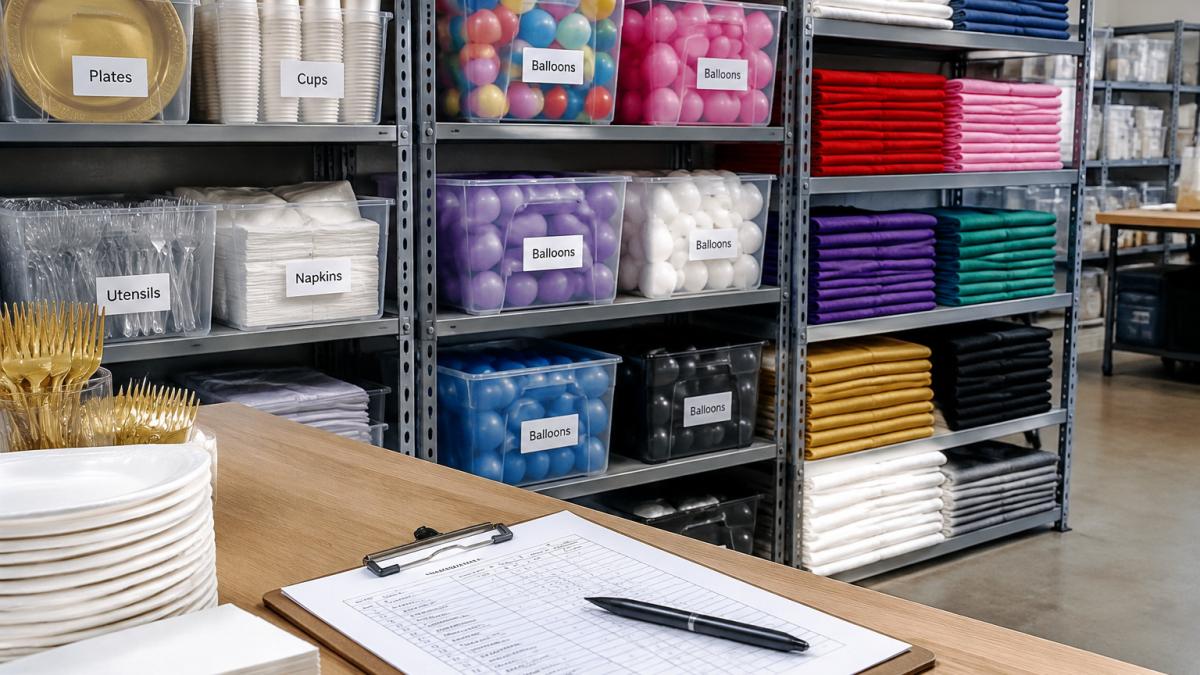
Set up a simple system:
- Label every bin by category, such as balloons, tableware or linens
- Keep a running count sheet or spreadsheet
- Note the condition of each item after every event
- Schedule cleaning and repair after each rental
- Rotate stock so older items sell or rent first
Track inventory turnover, too. Items that sit for months may need a discount or a new display. Items that sell out fast tell you where to reorder.
Protect outdoor decor from wind and weather. Our guide on how to secure outdoor balloon decor safely explains practical methods for anchoring and storing decor on event day.
Avoiding Common Sourcing Pitfalls
Most wholesale mistakes are predictable. Watch for these common problems:
- Ordering without samples. Photos can hide cheap materials.
- Ignoring total landed cost. Add shipping, duties and handling to the unit price.
- Overbuying trendy items. Trends fade quickly, so keep trend buys small.
- Skipping the contract. Get pricing, lead times and return terms in writing.
- Forgetting storage space. Bulk stock needs room, climate control and organization.
Each of these can erase the savings wholesale buying is supposed to deliver. A little planning up front avoids most of them.
Start Sourcing Your Next Order at RI Party Store
Sourcing wholesale event decorations for businesses takes planning, vetting and steady inventory habits. Refining your approach to choosing wholesale suppliers ensures that your procurement process remains scalable and resilient against market fluctuations.
If you want a local partner for party supplies, balloon décor and event rentals in Rhode Island and Southeastern Massachusetts, RI Party Store can help you plan your next event. Browse our website to request a current quote for your event.
Frequently Asked Questions
Where can I buy wholesale event decor?
Wholesale event decor is typically available from party supply distributors, manufacturers that sell direct to trade accounts, and specialty event rental and supply stores that serve professional decorators. Look for suppliers that publish minimum order quantities and offer a trade account application. Pricing depends on order size, product category, delivery location and timing, so request a written quote before committing. For current pricing and trade options on party supplies, rentals and balloon décor, contact RI Party Store directly through our website.
What documentation is required to purchase wholesale event decorations?
Most wholesale suppliers ask for a business name, a federal Employer Identification Number (EIN), and a resale or sales tax exemption certificate issued by your state. Some suppliers also request proof of business address, a business website or social media presence, and references from existing trade customers. Having these documents ready shortens approval time. Requirements vary by supplier, so confirm the list before submitting an application.
What is the difference between buying from a reseller and a direct manufacturer?
Direct manufacturers usually offer the lowest unit cost but often require higher minimum order quantities and longer lead times. Resellers and distributors carry a wider range of products in smaller quantities, which suits businesses ordering a mix of items. Compare total landed cost, including shipping and handling, rather than unit price alone. Both channels can work well depending on your order volume and how often you restock.
How can event businesses manage inventory costs through wholesale sourcing?
Track which decor items rent or sell most often and reorder those first to avoid tying up cash in slow-moving stock. Set reorder points based on your supplier’s lead time, and buy in quantities that match your booking calendar rather than stocking for every possible event. Label and store items properly so damaged or missing pieces are caught early, reducing replacement costs over time.
