
How to Safely Supervise Multiple Kids in a Bounce House
Last Updated: November 2, 2026
Quick Summary
To safely supervise multiple children in a bounce house, set a headcount limit before play, group kids by age and size, and run short timed rotations. Assign one dedicated supervisor at the entrance and do headcounts before entry, midway, and before exit.
- Set the headcount limit before the first child jumps and tell all parents.
- Group children by age and size, keeping toddlers in their own sessions.
- Use a countdown timer of about five minutes per rotation, shorter for toddlers.
- Count children out loud before entry, at the midpoint, and before exit.
- Stop play immediately if the wind picks up or the unit shifts.
Table of Contents
- Why One Adult Cannot Watch a Full Bounce House Alone
- Step 1: Set the Headcount Limit Before Kids Jump
- Step 2: Group Children by Age and Size
- Step 3: Post and Enforce Bounce House Rules for Kids
- Step 4: Run a Rotation, Headcount, and Supervisor Handoff System
- Step 5: Apply Core Bounce House Safety Rules During Play
- What to Do When Rules Are Ignored or a Child Gets Hurt
- Booking Your Bounce House and Setting Up Your Supervision Plan
- Frequently Asked Questions
Why One Adult Cannot Watch a Full Bounce House Alone
Supervising a bounce house sounds simple until five kids are bouncing at once. Then it gets hard fast. Kids flip, push, and collide, often in seconds. One adult standing at the side cannot track every child at the same time, which is why learning how to supervise multiple children is the core problem this guide solves.
The safest rule comes from the Center for Injury Research and Policy at Nationwide Children’s Hospital guidance on inflatable bouncer safety, which says the safest use is one child at a time. When several children must share the unit, they should be close in age and size. Most families cannot meet that ideal every time, so the plan below helps you manage the reality.
Research published in PMC also stresses responsible adult supervision throughout use. Supervision is not a background task. It is a job someone has to focus on. Study on whether inflatable play structures are safe for children
- One adult cannot track every child’s position
- Collisions and flips happen without warning
- Crowding raises the risk of falls and injuries
Step 1: Set the Headcount Limit Before Kids Jump
Decide the maximum number of children before the first child climbs in. Check the unit’s capacity sign and the rental provider’s instructions. Then set a lower number if your group includes younger children.
Write the number down and tell every parent. Keep it visible near the entrance. Changing the limit mid-party leads to arguments, so settle it early.
Watch out: A bounce house that looks roomy can still get crowded fast. Count the children, not the open space.
Step 2: Group Children by Age and Size
Sort children into groups before play starts. Mixed sizes are where injuries happen. A large child can knock over a toddler in a single bounce. The goal is to keep each session within a narrow range of height and weight so that collisions are less forceful and play styles match.
Use these sample groupings as a starting point, then adjust to the unit’s capacity sign and the rental provider’s instructions: see the full bounce house safety checklist for parents for more detail.
- Toddlers (roughly 2 to 4 years old) on their own, or with other toddlers only. Keep the group small, often three or four children, and shorten turns to three minutes.
- Young children (roughly 5 to 7 years old) of similar size in the same session. A group of four to six works for many standard units, but never exceed the posted capacity.
- Older, larger kids (roughly 8 to 12 years old) in a separate session. They bounce harder and need more space, so keep the group at the lower end of the capacity limit.
If you have a mix of ages, run separate sessions for each group. This takes more time but cuts down on accidents. For a single adult supervising multiple children, write the group assignments on a clipboard and call each group by name or color. A simple rotation, toddlers first, then young children, then older kids, keeps the crowd moving and gives each group a clear turn. Between turns, give children of different ages simple shared roles, such as helping call the next group, to engage siblings of different ages without crowding the bounce house.
Adapt the groupings to the unit. A small backyard bounce house may safely hold only two or three toddlers at once, while a larger unit with a higher posted capacity may handle five or six young children. Always check the capacity sign and ask the rental provider for guidance. If the group is larger than the unit can handle in one session, split into more sessions rather than crowding children in.
Watch out: A bounce house that looks roomy can still get crowded fast. Count the children, not the open space, and never let a larger child join a toddler session just because the unit looks empty.
Step 3: Post and Enforce Bounce House Rules for Kids
Post your rules where every child and parent can read them. Keep the wording short. Kids follow rules they understand.
- No shoes or sharp objects inside
- No flips, pushing, or rough play
- No food, drinks, or gum inside
- Only one child per entry at a time
- Stop immediately when the adult says stop
Read the rules aloud before the first session. Repeat them when new children arrive. Enforce them the same way every time, with no exceptions for favorites.
Step 4: Run a Rotation, Headcount, and Supervisor Handoff System
A rotation keeps the group small and the play controlled, and it is the simplest way to supervise multiple children at once. Use a countdown timer, such as five minutes per session. When it beeps, the group exits through the side door, and the next group enters. Shorter turns of a few minutes often suit toddlers, while older children may handle slightly longer turns. Adjust based on the unit’s capacity sign and the rental provider’s instructions.
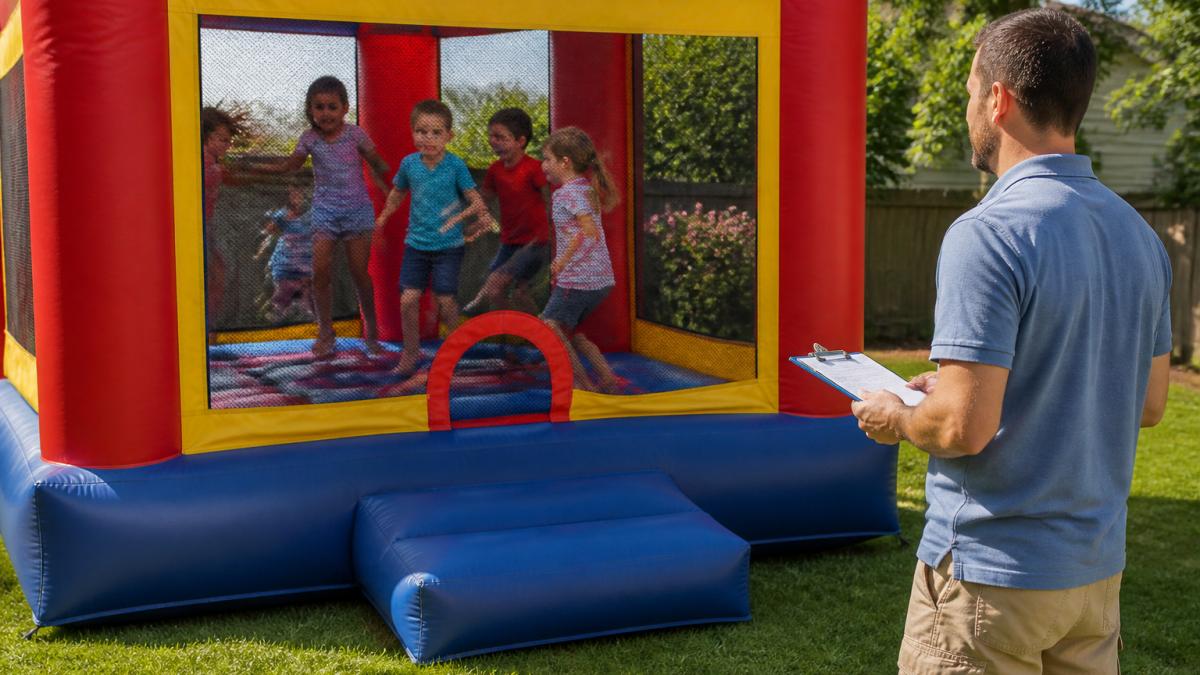
Do a headcount at three points: before entry, at the midpoint, and before exit. Count out loud. If the count is wrong, stop play until it is fixed. A simple script helps: “I count five kids in. I see five kids. Now I count five kids out.” For a single adult supervising multiple children, position yourself at the entrance corner where you can see all four walls and the entry. Use a physical counter or a notepad to track entries and exits if children are moving in and out frequently.
Assign one dedicated supervisor per bounce house. That person stays at the entrance and never leaves the unit unattended. If a supervisor must take a break, hand off to a named adult and say so out loud. Confirm the handoff with a quick headcount. A handoff checklist can be as simple as: “You are now the supervisor. There are five children inside. The rules are posted. The timer is set for five minutes. I will be back in ten minutes.” Both adults should repeat the count and the time.
When one adult is responsible for several children, recruit a second adult before play starts if possible. If not, reduce the number of children inside to a number you can track with a single sightline, often three or four for younger groups. Keep a written headcount sheet near the entrance and mark each child in and out. This creates a record and makes it harder to lose track during distractions.
Watch out: A supervisor who checks a phone or chats with guests is not supervising. Make the job clear and visible, and treat the handoff as a formal transfer of responsibility, not a casual wave.
The table below sums up the key timing and counting steps from the rotation system so you can check them at a glance.
| Check | When | How |
|---|---|---|
| Headcount | Before entry | Count children out loud |
| Headcount | Midpoint | Count again and compare |
| Headcount | Before exit | Count out loud before stopping play |
| Session length | Each rotation | Countdown timer, about five minutes |
| Toddler turns | Each rotation | Shorter, about three minutes |
| Supervisor | Whole session | One dedicated adult at the entrance |
Step 5: Apply Core Bounce House Safety Rules During Play
During play, stay near the entrance where you can see the whole unit. Watch for children who are too rough, too close to the edges, or climbing the walls. Step in early, before a problem grows.
Check the weather before and during the event. Wind can lift the unit and make it unsafe. Stop play if the wind picks up or if the unit shifts. Check that the anchors and stakes are secure. Keep the entryway clear of toys and debris.
Keep an eye on toddlers in particular. They have less control and are easier to knock down. If a child seems hurt, stop play at once, call the parent, and follow your emergency plan.
What to Do When Rules Are Ignored or a Child Gets Hurt
Warn a child once. If the behavior continues, remove the child from the bounce house for the rest of the session. Tell the parent what happened, calmly and clearly.
If a child is hurt, stop all play immediately. Check on the child and call for medical help if the injury is serious. Keep the group out of the unit while you handle the situation. Record the time and details so you can share them with the parent and rental provider. For guidance on properly cleaning the rental unit step by step afterward, follow the cleaning instructions.
Repeated rule-breaking is a sign the group is too large or mixed in size. Reduce the number of children for the next session.
Booking Your Bounce House and Setting Up Your Supervision Plan
Plan your supervision before the event day. Decide your headcount limit, your age groups, your rotation timer, and who the supervisors are. Write it down so every adult knows their role.
When you are ready to book, RI Party Store bounce house rentals in Rhode Island and Southeastern Massachusetts can help you choose a unit that fits your group size. You can also compare bounce house rental options in Rhode Island before you decide. Ask the rental provider for the unit’s capacity and setup instructions, and share your plan with them.
For ideas that fit a small group, see our guide to kids birthday party ideas for small groups.
Frequently Asked Questions
How many kids should be in a bounce house at once?
The safest approach is one child at a time. Nationwide Children’s Hospital’s Center for Injury Research and Policy recommends this, and says that if several children use the bounce house together, they should be about the same age and size. Manufacturer capacity limits are a maximum, not a target, so many parents choose a smaller group that one adult can actually watch. Pricing for your rental depends on quantity, date, and delivery, so check RI Party Store’s website or request a quote for current options.
How many adults should supervise a bounce house?
Plan for at least one dedicated adult supervisor whose only job is watching the bounce house. Responsible adult supervision with close attention throughout use is a widely recommended safety practice. If the group is large, add a second adult for headcount and entry control so the supervisor can focus on play. A supervisor who is also hosting, serving food, or managing other guests cannot keep close watch on several children at once.
Should children of different ages bounce together?
Ideally, no. Nationwide Children’s Hospital’s guidance says that when multiple children use a bounce house, they should be similar in age and size. Separating toddlers from older children prevents smaller kids from being knocked down or stepped on. If you must mix ages, use a shorter time block for the younger group and keep a closer eye on collisions and rough play.
Is 7 too old for a bounce house?
A bounce house is generally designed for young children, but the real question is size and behavior rather than age alone. A seven-year-old who is much larger than the other children in the group may need a separate turn to avoid collisions. Check the manufacturer’s weight and height limits, and when in doubt, have children take turns one at a time so the supervisor can manage each jumper safely.
